
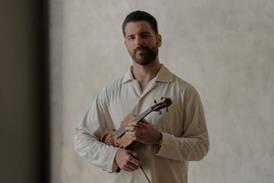
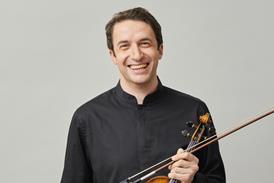


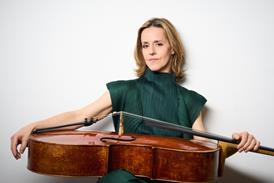




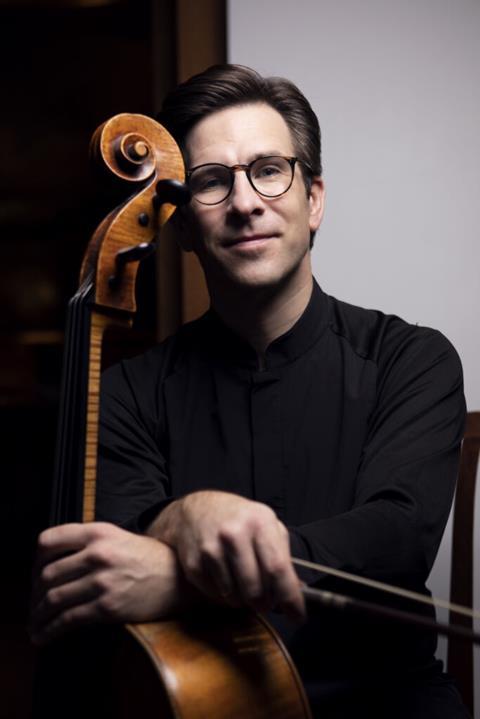
Cellist Guy Johnston, president of ESTA UK, has recently completed his studies on the ESTA Education PG Cert course in practical instrumental teaching. Eve Kennedy speaks to him to hear more about his teaching work and his experience of the course
Read more Featured Stories like this in The Strad Playing Hub
What you were like as a teacher before taking the ESTA (European String Teachers Association) Education PG Cert course?
GJ: Well, I was learning on the job! The backbone of my teaching comes from my mentors Steven Doane, Steven Isserlis, and David Waterman, who were all taught by Jane Cowan. In fact, one of my first essays for the ESTA PG Cert course was examining my ‘musical heritage’. I started to investigate, looking back at my teachers’ lineage, and went back even further to Casals. I always remember him being referenced in lessons, and so I had a lot of fun delving into Maurice Eisenberg’s manual, Cello Playing of Today, which was inspired by the wisdom of Casals, and finding all the connections that I could make with my own teachers.
I liked to play along with my pupils to give them that comfort and support in a lesson – whether that was playing another part from the score, demonstrating, or playing a few harmonies on the piano. Sometimes I would just leave the cello to one side and teach verbally the whole lesson, and that gave me a different kind of freedom in the teaching.
But somehow there is a kind of back-and-forth when you play. What you hear and what you give back, and what the student hears and what they give back. You need to work on getting the balance right. I would say, in the past, I haven’t thought enough about the impact of what it is to demonstrate. If the demonstration isn’t going well, you need to be able to explain why. Practice is about trial and error – we’re all human, and it’s not all about perfection – but as long as you can describe the process, I think that also helps the student to think more critically of themselves and their own process.
As a teacher, everything that you’re used to comes from those very special one-to-one sessions, from masterclasses you’ve had, seeing your idols and mentors and the way they work. It’s a kind of parenting, I suppose – musical parenting. And that became more complex as I went back to Eastman to teach: Steven Doane has got such a legacy there, and it was an honour for me to go back. Initially I sought a lot of advice from him, but then I realised I had to go and find my own path, and the PG Cert course has been an extension of that, helping me to grow.
Do you think that pupils subconsciously pick-up idiosyncrasies from their teacher’s playing?
GJ: I think a great compliment would be, ’Oh, wow! All your students look so different, or sound so different’. Growing up, I always had an expectation that you belonged to a particular school of playing. I look at a lot of great cellists from the past and who are out there at the moment, and they have such different styles, and they make it work for themselves.
What I often say to students is, ’Look, this is the information that I have come to know, and it works for me. You can take what you want and leave what you don’t want.’ I try to pass on hints I’ve picked up along the way. Then they’ve got to make it their own. I think that’s the one thing I always say: make it your own. We’re trying to raise individuals, and uniqueness, to open pathways for students to thrive. That’s where demonstrating can potentially get in the way, because we pass on things that we’re not meaning to. There’s also nothing worse than hearing yourself coming back at you!
One thing I always say: make it your own. We’re trying to raise individuals, and uniqueness, to open pathways for students to thrive
How do you feel your teaching has changed during the past year having taken the PG Cert course?
GJ: I think it’s always evolving. Maybe there’s a lot that remains the same because that’s just who I am inherently, but I think what’s changed is the way that I reflect on a session, how I choose to use the time I have with the students, and responding more to the student’s needs in any given moment.
In the past I’ve always expected students to turn up with something, and to be motivated, but that’s just not the case for everyone. Some of them really need goals and a plan.
One of the assignments I had to do was to create a curriculum for a first-year undergrad student, and I’ve actually suggested to one of the students coming to study with me at the RAM that they be a guinea pig for this curriculum. They’re up for it, and I’m curious to see how it impacts the teaching and learning process. It will incorporate listening to particular works each week, reading materials, working on certain studies, exercises, and timeline for when I’d expect to hear something in class.
So there’s a real sense of momentum and focus to the learning.The course has really helped me with these elements: knowing how to pace a term, or a year, with a student; responding to their needs and being able to adjust; short-term and long-term goals; and trying to keep them on track.
One of the important takeaways of the course for me was learning how to read a room. I have memories of applying what I was learning on the course to the teaching room at the Menuhin School as well as at a class I gave for over 100 musicians in Abu Dhabi at the Young Musician of the Gulf Competition. Once you understand and engage with what’s in front of you, you can go almost anywhere in the session or lesson. It is about connection, interaction, and a dialogue between teacher and pupil. I learnt a lot about teacher-led versus student-led lessons. I think one needs to strike a balance between the two.
We also had to prepare a five-minute video talking about a technical idea. We then had to show how to integrate that idea in a one-to-one session. I found this fascinating – learning how to speak clearly about an idea, and how to put it into practice with a student.
We were given lots of reading materials as part of our studies. I drew on some of the texts that I’ve been reading myself (I read a lot of materials during Covid, and at Eastman I read, and read, and read – different manuals, treatises), and that helped me to formulate some ideas. I was able to draw on these different elements that I found through my own search. And that makes it quite fun during the teaching process because you feel like you’ve just made a great discovery, and you can’t wait to share that with the students.
I used to do that at Eastman when I made a discovery: I would send my pupils a scan of the paragraph, or I’d send them the exercise with a bit of blurb about it. It was just infectious to me. I thought, ’I can’t keep this to myself – I’ve got to pass this on’. And then the student will get a chance to learn information that we might not touch on in an hour’s lesson. In their own time, they’re exploring, and I’m hoping that will give them the motivation to go and make discoveries for themselves.
For my curriculum, I think we’re going to start with the Eisenberg Cello Playing of Today, because there’s a lot in there that still relates today.
How did you find that you were able to fit the course around your busy playing career and your family?
GJ: The course leaders were very understanding. If I needed an extension, it was possible, but they gave us plenty of heads-up about what was coming. The supervisors really help to steer you in the right direction and give you feedback. I would say that it’s incredibly well paced, and organised. You can watch the online webinars in your own time, and discuss your thoughts in the community forum.
Getting it down – writing stuff on paper – is such a challenge: to formulate your ideas, and to know what you’re thinking, and articulate what you mean to say. It really encouraged me to search more deeply, and connect with what I’m doing.
Obviously it’s a commitment – financially, and making the time – but if teaching is becoming your thing, and if you want to feel empowered in the classroom or in the studio, then I would say go for it. If you’ve got a passion and a curiosity, and a desire to learn and grow, at any age, it’s absolutely worth the investment. I came away from each assignment feeling that bit more established in myself and in what I thought. I feel quite proud now I’ve got my PG Cert: I’ve got something to show for it and I am educating myself.
I think in the end, teaching is a very instinctive art, but if you can train and hone your instincts with more knowledge, then it gives you encouragement and confidence in all sorts of different moments when teaching. And yes, I must admit I’m still failing! But I feel like I’ll do a better job than before, having taken the course.
Teaching an instrument is such a highly-specialised discipline. How does the course stay relevant to each PG Cert student, given the variety of teaching settings, age groups, and abilities they are working with?
GJ: When I did the Dalcroze sessions at the summer school, I just had such fun. It made me feel young again, and I found myself taking that same sense of fun and activity and play into my practice and teaching room. That sense of movement, of collegiality and community – all the things that you miss with the isolation of being on your own.
The course is great for giving you the overall structures and ideas, and it also gives you the freedom to explore whatever you need to at this stage in your teaching development. You’re reminded of what it is to build from the foundation. There’s something that you can take from every subject, and you can then focus in on what is important to you, so that the assignments actually connect with what you’re confronting at any stage in your teaching career.
How do you see the role of a teacher – a master, a professor, a mentor, a coach, an ally?
GJ: A mentor and an ally. You are there to advocate for the student. However, you’ve got to be critical. You’ve got to make the students listen critically, and be honest with themselves about what they’re hearing, and what’s actually happening. I’m trying to lead by example – how I would deal with situations myself. And I hope that they see me as an example of what they could be considering for their own future – a role model of sorts.
But, as before, I don’t want them to become carbon copies. Bernie Greenhouse, cellist of the Beaux Art Trio and a student of Casals, said he got to a point where he found himself trying to be ’a mediocre example of Casals’.
Of course many students have an innate ability and talent, and you don’t want to get in the way of that. So, actually, less is more. The question is: ‘What’s the most useful, valuable thing I can add at this moment, that will just continue to inspire them?’
I used to go for sessions with Ralph Kirschbaum in London, after I’d already graduated and was well into the profession, and I would take him concertos that I was learning. I left with such a spring in my step because he was able to focus me, and get me to concentrate at such a deep level. It felt like anything was possible if I could get to that place, and that’s where I wanted to get back to in my own practice – that feeling, that, kind of, energy, focus, and complete devotion. And I think that’s the key to teaching and helping students to become independent musicians.
The ESTA Education PG Cert is a one year course in practical instrumental teaching and pedagogy, with the option to continue to year 2, with or without a break in between, to obtain an MA degree, awarded by the University of Chichester. The course is entirely online with the exception of a five-day summer school in-person at the beginning of the course. ESTA Education is enrolling now for courses commencing in August 2026. For further details, please visit: estaeducation.co.uk.
Read: Opinion: How a performing career and teaching work hand in hand
Read more Featured Stories like this in The Strad Playing Hub









No comments yet