


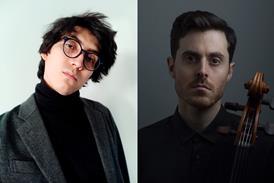



Composer James Díaz tells Thomas May how working with cellist John Popham led him to rethink his scores and discover new possibilities in the instrument’s smallest resonances.
Discover more Featured Stories like this in The Strad Playing Hub
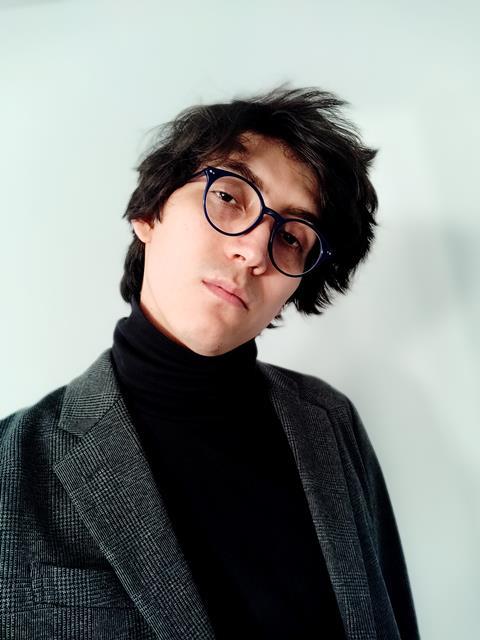
New York-based Colombian composer James Díaz is known for orchestral, chamber and electroacoustic music built from densely layered textures and shifting sonic patterns. On his new album, Espacio absoluto (New Focus Recordings), Díaz explores how much of that complexity can be created by a single cello.
Across nine pieces for cello and electronics, the instrument creates the illusion of multiple layers of sound through an extraordinary variety of playing techniques and timbral effects, without multitracking the cello.
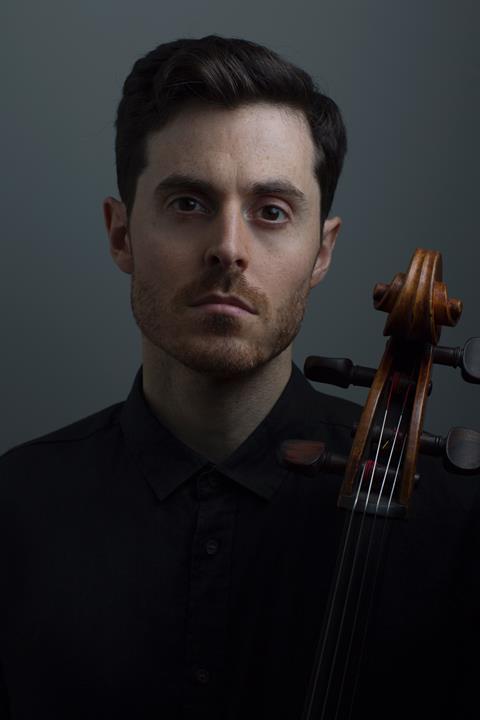
Díaz first collaborated with Seattle-based cellist John Popham in 2018, when he wrote a piece for Popham’s trio Longleash. Their friendship and continuing musical dialogue eventually led to Espacio absoluto, which they developed over two years of close collaboration.
In this interview with US correspondent Thomas May, Díaz discusses the discoveries that shaped the recording and how the cello’s familiar singing voice takes on new significance within his imagined sonic landscapes.
Your music often involves intricate layers of sound. What attracted you to the challenge of creating an entire sound world with just one cello?
James Díaz: In 2023, John Popham began playing my solo cello piece En tiempos de voz pasiva (In times of passive voice), and his interpretation expanded the work in ways I hadn’t initially imagined.
Working with John opened up new possibilities. Eventually we conceived a larger solo cello project, this time with electronics but without multitracking the cello: one solo cello, one solo track. The challenge was to create the illusion of multiple layers within a single instrument, expanding the counterpoint of colours and textures through one performance.
Close microphone capture helped bring some of the studio’s immersive quality into the project. All the pieces are possible in live performance, but the studio makes the layers much more detailed. Resonances that can be lost at a distance in a concert hall become very present and alive.
How did your collaboration with John Popham develop, and how closely did you work together as these pieces took shape?
Díaz: I met John in 2018, when I wrote In her dream song for his trio Longleash. The piece became part of their repertoire, and we became friends. This album grew out of years of listening closely to John and being amazed by his approach to performance.
We worked together over two years. Just as we were about to begin a residency at the Avaloch Farm Music Institute, John got Covid, so we isolated together in New York. It was a strange situation, but honestly, some of our most productive and lovely days. I also like cooking for my collaborators, so it gave me a chance to take care of him while we worked.
Some passages grew out of John’s suggestions and discoveries. That’s one of the most valuable things about working closely with a performer: no one knows an instrument more intimately than someone who practises it every day.
The music explores a remarkable range of cello techniques, from ricochet and bariolage to multiphonics. Were there any sounds or possibilities you discovered along the way that particularly surprised you?
Díaz: I think of my process more as sculpting than building: I start with a large amount of material and gradually discover what belongs.
The multiphonics were particularly interesting. Their character was very specific to John’s bow pressure and the resonances of his cello, so I wanted to let him move freely in and out of them. For Interludio II, we recorded excerpts in the studio that I then took home, recomposed and renotated before recording the final version.
But some of the most important discoveries were subtler. The cello can produce the same pitch through different types of harmonics and in different positions. Small differences in resonance, spectrum and presence could completely change the character of a passage. Those discoveries often shaped the music’s larger architecture.
When composing music that depends so much on the physical possibilities of the instrument, how do you decide what to specify in the score and what to leave to the performer’s imagination?
Díaz: I tend to notate enough to answer the important questions about realising the music, while leaving room for the performer’s physical knowledge of the instrument.
I repeatedly recomposed and renotated ideas based on John’s feedback, so the final scores contain a lot of specific information. We also made adjustments during recording, particularly with circular bowing, which I use throughout the album, especially in Desiertos verdes. That technique needs a particular musical context to work clearly. So sometimes the notation is very specific, while elsewhere it provides more of a framework, with the recording helping clarify the intention.
I often use performer interactivity as a compositional technique, allowing free insertions during repetitions or asking performers to choose between two materials. For this album, however, I deliberately avoided those strategies because I wanted greater control over form and phrasing. The freedom is therefore less about structural choices and more about how John physically realises the music.
Alongside the unusual sounds and textures, there are moments of striking lyricism and melancholy. What draws you to the cello’s singing voice, and how does it fit into the world you’re creating here?
Díaz: I think of the nostalgia and melancholy in pieces such as Espacio absoluto, Grand Oasis and A Warm Place without Memory as references to a ‘past’, almost like time capsules. Because the album plays with fictional spaces, lyrical lines and vocal-like tones become a way to place the listener inside those environments. Some sections focus primarily on the environment itself, its echoes and illusions of space and time, while fragmented melodic material creates a back-and-forth between what feels real and unreal.
I’ve also been thinking about how our field’s fascination with extended techniques can sometimes overlook the fact that tone itself can become an extended technique when its context changes. Deciding where a little or a lot of vibrato appears became very important to me. It can evoke the tradition of lyricism while also amplifying the cello’s resonance. So the singing quality is not necessarily a return to something familiar; it becomes another way of transforming the instrument and its context.
The album moves through nine pieces, including three interludes, before ending with the otherworldly sounds of Espacio tiempo. Did you conceive it as a single musical journey from the outset, or did that larger shape emerge as you worked on the individual pieces?
Díaz: The pacing of the individual pieces and the album’s overall form emerged through the sculpting process rather than from a fixed plan. The three interludes emerged as moments of textural isolation and modal focus, reflecting on what comes before or after them.
I was very conscious of how the endings and beginnings of each track could create transitions, so the album would gradually feel like one continuous space. Some of those connections came naturally through open strings and natural harmonics. For example, the D harmonic at the beginning of Espacio absoluto leads towards G through a highly distorted modal environment. By the end, the final multiphonic contains a spectral collection based on D, creating an otherworldly landscape that feels much farther removed from the opening.
The album’s larger metaphor moves from Espacio absoluto, or absolute space in Newton’s theory, towards Espacio tiempo, or spacetime in Einstein’s theory, where harmony and timbre become dimensions of the same space.
Espacio absoluto is available on the New Focus Recordings label. Find out more here.
Read: Six composers, one instrument, incredible variety: ‘for cello, by cellists’
Read: Getting closer: exploring music for the cello on Colin Riley’s new album ‘Ones Twos and Threes’
Read: ‘Take the risk’: Alexander Hersh on building a visual world around new music
Discover more Featured Stories like this in The Strad Playing Hub









No comments yet