



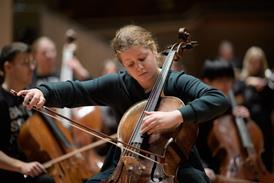















Cellist Juliana Soltis recounts the century‑long disappearance and improbable rediscovery of Helen Crane’s An Elegy, a 1919 prize‑winning work lost in the depths of Library of Congress catalogues and revived through a cross‑institutional sleuthing effort worthy of its own mystery novel

Read more Featured Stories like this in The Strad Playing Hub
I have a confession to make. I, Juliana Soltis – cello soloist; mother of greyhounds; devotee of unnatural hair colours – am something of a music nerd. It’s shocking, but true: I get misty-eyed over hand-written manuscripts.
I have a recurring dream about miraculously single-handedly rediscovering the autograph copy of the Bach cello suites. And they think I’m joking, but I would probably live at the New York Public Library for the Performing Arts if they would let me. Which is all to say that it should come as no surprise to anyone that, when confronted by the spectre of a mysteriously disappeared piece of music, I simply couldn’t let it go.
It began innocently enough: a mention, in the July 1919 issue of The Musical Monitor, of a Helen Carver from Scarsdale NY – winner of the National Composers’ Prize Competition in the category of Cello Solo. The mysterious ‘Helen Carver’ was in fact the noteworthy American composer Helen Crane, and this notice was but one of many fragments of information with which I was attempting to reconstruct the narrative of her extraordinary life and career.
This item, though, sparked a little more interest than the dozens of reviews, concert programmes, trans-Atlantic passenger manifests, and passport applications over which I had been poring for months. A prize-winning cello piece? My fingers were twitching in anticipation!
I was already well-acquainted with another of Crane’s compositions: the Six Idylls for Cello and Piano, op. 52, which I had just finished recording for my album American Woman. I had found that work, along with the rest of her papers, safely tucked into archival boxes at the aforementioned New York Public Library for the Performing Arts – but this work, titled simply An Elegy, was curiously not among them. There were some sketches – brief snatches of a work-in-progress drawn lightly in pencil in a tidy, flowing hand – but no fair copy.
A quick survey of Crane’s other papers soon revealed the reason why: in 1940, the Library of Congress in Washington DC requested this prize-winning score for inclusion in a special collection they were building to specifically document and preserve works by the laureates of the National Composers’ Prize Competition. The New York Public Library, by then already custodian of Helen’s estate, acquiesced; and the Library of Congress acknowledged receipt of the manuscript that same year.
‘Brilliant!’ I congratulated myself; this mystery work was now just one simple search of the Library of Congress database away from landing on my music desk… or so I thought. No matter how I modified my search (in a last-ditch effort, I even tried the misnomer ’Helen Carver’, just in case), the screen before me inevitably deadpanned ‘No Results Found.’
What was going on? Frustrated and finding myself at an apparent dead end, I decided that it was time to apply to a higher power: the Performing Arts Reference Librarians of the Library of Congress. In a form-submitted email, I poured out the details of my search: The Musical Monitor; the prize-winning work; the request and receipt; the blank, mocking search screen. Could they help me?
And some time later, the response:
Unfortunately, I’m not showing any record of this work in our collections. However, I’ve reached out to the NYPL to review the correspondence in their collection that refers to this work…
…which is when things started to get interesting.
As flurries of emails flew back-and-forth between librarians in DC and New York, it was confirmed that the Crane ‘Elegy’ had indeed been sent by the New York Public Library in 1940, and had in turn been received by the Library of Congress – where it apparently had stayed. In decades of library records, there were no requests for the material: no indication that it had ever left Washington DC.
It soon became clear that the mystery of its location must be an open secret known only to the old card catalog system: that leviathan relic of pre-digital days. When consulted, the record – carefully entered onto a three-by-five inch card decades ago – revealed the missing work to be not only safe and sound, but on the shelf exactly where it was supposed to have been for the last 84 years.
First performed at the Eleventh Biennial Convention of the National Federation of Music Clubs on 2 July 1919, An Elegy was (uncharacteristically for Helen) deemed something of a dud: ’Little can be said in praise,’ sniffed W.A. Murray of The Musical Monitor. Perhaps Murray, who was far more enamoured of the Romantically-tinged works by Amy Beach presented on the same programme, objected to the jarring harmonies and intense chromaticism that nodded to Crane’s exposure to the music of the early Expressionists during a career that had, to that point, been spent largely in Berlin.
Or perhaps it was what those strident, anguished sounds represented: in an elegy strangely dedicated to no one, but instead possibly meant for everyone who had perished in the Great War, Crane was writing of unspeakable loss and the inherent fallacy in the idea that any war could end all wars.
In the aftermath of that great cataclysm, an idea began to take hold: that the only way to avoid any similar future tragedy would be through a spirit of cooperation. It seems fitting, then, that the rediscovery of this work was an intensely collaborative effort that crossed borders and united myriad professionals across disparate disciplines before landing myself and pianist Emile Blondel in the SiriusXM studios in New York.
On a clear March morning that still felt far more like winter than spring, the notes of Crane’s paean for the lost rang out for the first time in more than a century. Originally intended as part of a Women’s History Month presentation for SiriusXM subscribers, we are thrilled to be able to share this work with the world in a special collaboration between PARMA Recordings and SiriusXM. Mr. W.A. Murray of The Musical Monitor might still be unimpressed (were he around today), but we hope that Crane would be proud.
American Woman: Helen Crane (An Elegy Rediscovered) is released on Navona Records on 20 March 2026, featuring cellist Juliana Soltis and pianist Emile Blondel.












No comments yet