




Ulrich Heinen explores the hidden architecture of Bach’s Cello Suites and how a ’missing’ bass line can invite the performer and listener to interact with the music
Read more Featured Stories like this in The Strad Playing Hub
Senza Basso.
The fact that Bach’s Cello Suites are titled senza basso (without bass) gets little attention. Most printed editions omit this. And yet in my opinion it is an important detail.
Senza basso indicates that there is no basso-continuo part provided, usually expected during Bach’s time.
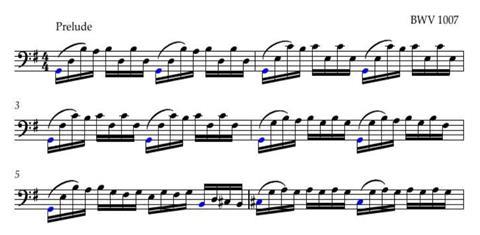
Instead, the bass is an integral part of the composition itself, expressed by the lowest notes of passages, chords and arpeggios.
For instance, in the beginning of the Prelude of Suite 1 (bass-notes high-lighted in blue):
Or in the Prelude of Suite 2, bars 13 to 23:
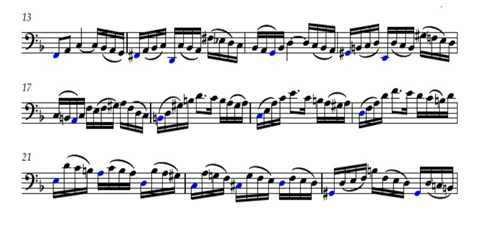
This might seem of academic interest only, were it not for the fact that the bass is occasionally missing and left to the imagination of the listener.
Leaving out elements of the composition serves two purposes:
Firstly, it enables the composer to outline a more complex composition than the limitations writing for a single string instrument would otherwise allow.
Secondly, it invites the audience to become an active partner in the communication by enticing the listener to mentally complement the composition, i.e. subconsciously fill in missing gaps.
For the performing cellist, who is trying to find a meaningful interpretation, most instances of ‘missing basses’ are of little relevance.
But there are some occasions where it is important to reflect on what the ‘imaginary bass’ might be.
I have therefore listed below eight passages from the Cello Suites where the awareness of the ‘missing bass’ is indispensable in my opinion:
1) In the beginning of Suite 2:
Imaginary bass notes added in red, bass-notes high-lighted in blue
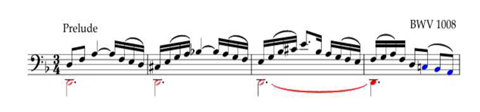
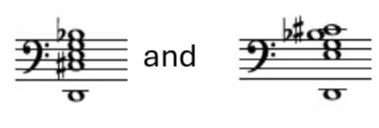
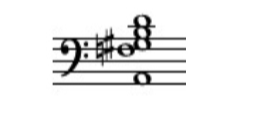
Only with the imaginary low D of bars 2 and 3 are these harmonies complete:
Diminished 4/2 + major 7th:
2) Later in the same Prelude of Suite 2, bars 39 to 48:
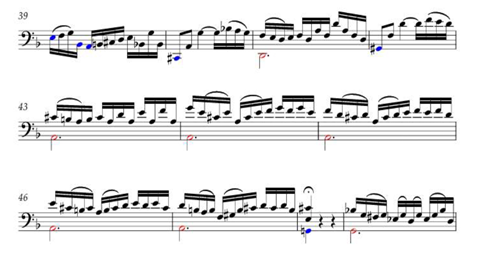
The bass note C# of bar 40 moves to an imaginary D in bar 41.
Similarly, the bass note G# of bar 42 moves to an imaginary bass A (one octave below the open A) and remains as imaginary ‘pedalbass’ for 5 bars, completing the dissonant harmony on the 2nd beat of bar 47 (diminished 4/2 + major 7th):
3) In the following bars of the same Prelude of Suite 2:
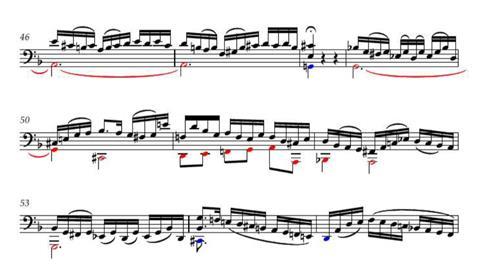
Bar 51 is a ‘cadence-bar’ with the imaginary bass forming an ascending D-minor scale.
This cadence is ‘deceptive’ (Trugschluss), leading to the submediant Bb major in the beginning of bar 52.
4) In the Prelude of Suite 3, bars 20 to 27:
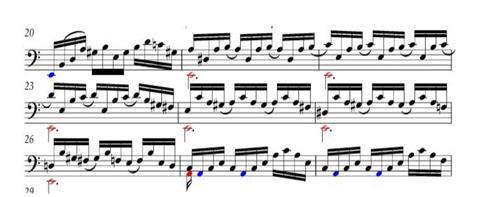
The bass E of bar 20 remains E in the following bars as an ‘imaginary pedal-bass’, extending the cadence to A minor by 6 bars.
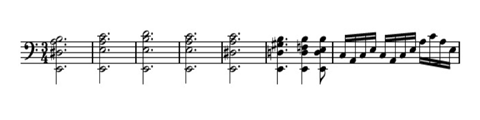
The chord progression in bars 21 to 27, omitting passing notes is:
5) In the Courante of Suite 3, bars 26 to 40:
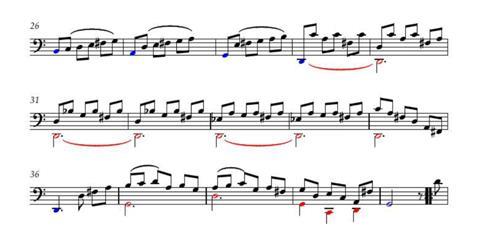
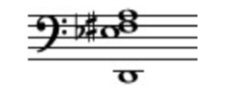
The bass D of bar 29 remains in place as ‘imaginary pedal-bass’ for 6 bars, completing the harmony (D major 7th with diminished 9th) in bars 33 and 34:
6) In the Prelude of Suite 5:
NB: In this Suite the suggested ‘imaginary’ bass-notes are Bach’s own. They are part of his Suite for the Lute (BWV 995 in G-minor), which is the same composition as Cello Suite 5.
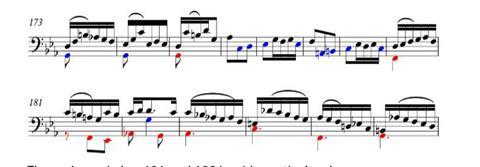
The cadence in bar 181 and 182 is a ‘deceptive’ cadence (Trugschluss), leading to Ab major in bar 183.
7) Similarly in the Gavotte 2 of Suite 5, bars 46 to 51:
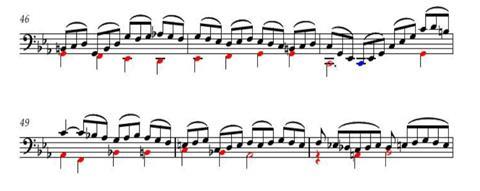
Again, the cadence at the end of bar 48 is a ‘deceptive’ one (Trugschluss), leading to Ab major in bar 49.
8) In the Prelude of Suite 6, bars 69 to 79:
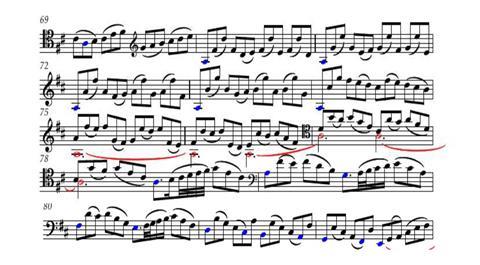
The ‘pedal-bass’ A of bar 70 to 74 (open A string) continues as ‘imaginary pedal-bass’ for a further 3 and a half bars until the middle of bar 78, going to G in the middle of bar 79. The chord progression in bars 75 to 78, omitting passing notes, is:

The ‘imaginary pedal-bass’ A completes the increasingly dissonant harmonies. It ensures the continuity of the dramatic tension moving forward to the lowest note, the low E in bar 82.
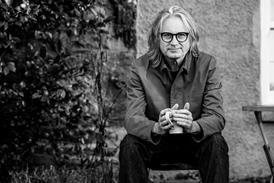
Ulrich Heinen was born in Ittenbach near Bonn, Germany. He studied cello at the Musik Hochschule Cologne with Siegfried Palm and with Leonard Rose at the Juilliard School of Music in New York.
After graduating he was appointed principal cellist of the Radio Symphony Orchestra Saarbrücken. At Sir Simon Rattle’s invitation, he subsequently moved to the UK and took up the position of principal cello and section leader of the City of Birmingham Symphony Orchestra (CBSO).
He co-founded Birmingham Contemporary Music Group (BCMG), today one of the UK’s leading ensembles for contemporary music. He recorded Mark-Anthony Turnage’s Cello Concerto KAI for EMI and Bach’s Cello Suites, together with contemporary works for cello for METIER.
He has taught at the Royal Northern College of Music (RNCM) and the Royal Birmingham Conservatoire. He gave masterclasses and lectures on J S Bach’s Cello Suites at the RAM London, RNCM Manchester, Australian National Academy of Music Melbourne, The Hong Kong Academy for Performing Arts and Central Conservatory of Music in Beijing.
All musical examples courtesy Ulrich Heinen.
Read: Why you shouldn’t practise Suites and Partitas with a metronome: Ulrich Heinen
Read: Did Bach dance? Stylised dance in his Solo Violin Partitas
Read more Featured Stories like this in The Strad Playing Hub










No comments yet