
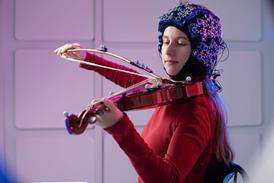





Davina Shum attended the 2026 Bergen International Festival, which showcased a range of programmes combining contemporary interpretations, traditional instruments and major orchestral works across multiple venues
Read more Featured Stories like this in The Strad Playing Hub
With an average of 240 days of rain a year, Bergen is considered to be the wettest city in Europe. Even at the height of summer, locals are dressed in their wet weather gear – from Wellington boots to rain trousers and anoraks.
Despite perhaps being a surprising climate therefore for a summer festival, the Bergen International Festival has been on the calendar of the Norwegian city since 1953. Edvard Grieg’s house in nearby Troldhaugen (though currently closed under renovation), plus panoramic views from Fløyen and fresh seafood from the harbour are just some of the attractions of the city.
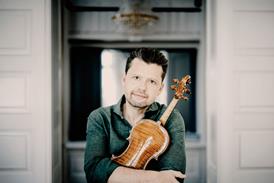
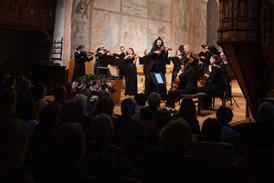
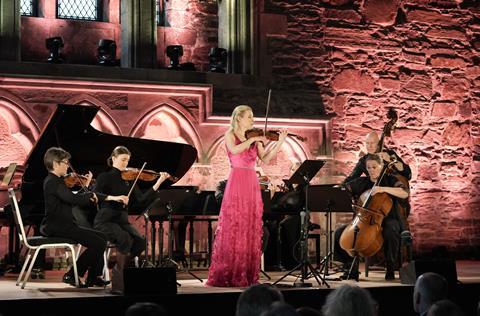
I visited the festival from 2 to 5 June, as the 2026 edition was well underway. My first stop was at Håkonshallen, a 750-year-old stone building overlooking the harbour that was formerly used as a royal residence and banqueting hall. It was here that the concert Colors of Bach was presented by home hero, the violinist Eldbjørg Hemsing.
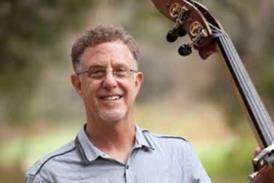
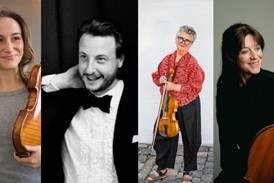
She was joined onstage by her colleagues – violinists Elise Båtnes and Liv Hilde Klokk-Bryhn, violist Ida Klokk-Bryhn, cellist Louisa Tuck, double bassist Kenneth Ryland, pianist Ole Christian Haagenrud and Gunnhild Tønder on harpsichord – for a programme comprising arrangements of many of Bach’s most popular works. We heard Bach in all shapes and forms, as Hemsing described the arrangements as ‘Bach through a different lens’. There were glimmers of familiar Bach melodies upon modern soundscapes and against backdrops of harmonies that would be right at home in a Taylor Swift song.
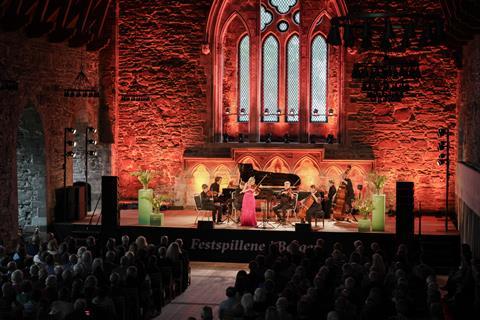
Hemsing stated that it was about time to take some new approaches to Bach’s music, a breath of ‘fresh air’ (referring indeed, to an upbeat version of the ’Air’ from Orchestral Suite no.3). Some arrangements worked better than others – Hemsing had to explain after the opening performance of the Prelude from Partita no.3 in E major BWV1006 that it was arranged in 5/8 meter, which explained why its groove felt somewhat awkward. The work I enjoyed the most was the E major Violin Concerto BWV1042, described by Hemsing as ‘the real deal’ – and this arrangement was largely left alone, leaving the language of Bach to speak for itself.
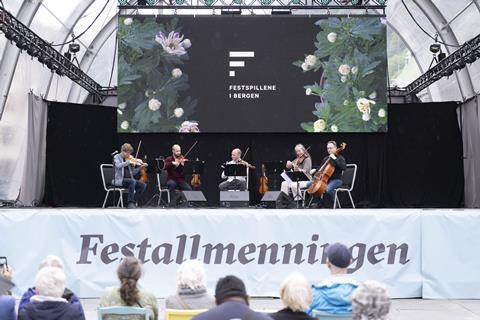
The following afternoon, I listened to the Hardanger ensemble Istem perform a 30-minute, informal concert at the festival square on Torgallmenningen in central Bergen. This hub held short performances throughout the day, free of charge and unticketed for people to wander in and see what was on offer.
It was a truly Norwegian experience to hear an ensemble of the national instrument; while sitting outside in the rain (the ensemble was on stage under cover, crucially). While the Hardanger fiddle has enjoyed a centuries-long legacy and international awareness, its viola and cello variants are relatively rare and new – the ones featured in Istem were built by one of the group’s violinists, Ottar Kåsa, who only started making Hardanger instruments in 2005, and was inspired to make a viola version for his colleague’s birthday. After the performance, ushers approached concertgoers with complimentary cups of coffee, presumably to help warm up chilly hands.
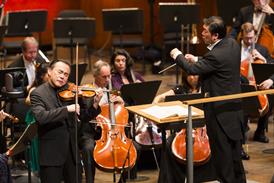
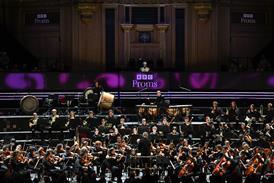
That evening, I attended Mahler’s Symphony no.2 at Griegshallen, performed by the Bergen Philharmonic Orchestra under Esa-Pekka Salonen. Entering the auditorium, I briefly wondered if I had taken a wrong turn, as I found myself on the same level as the orchestra. It soon became clear that the hall’s bowl-shaped design creates a steep gradient of seating, ensuring that every audience member looks down towards the stage.
This layout allowed the orchestra’s nuanced playing to be heard in striking detail, from the ominous unison of the lower strings in the opening to Mahler’s expansive Alpine melodies. The amphitheatre-like setting enhanced clarity, though in an indoor space it also intensified the more powerful moments, with some climaxes proving overwhelmingly loud. By contrast, the quieter passages were beautifully projected. Soprano Mari Eriksmoen’s delicate entry, after her long wait onstage, was particularly notable– her voice emerged with such ease and control that it was like a string player making an up-bow entrance without any bow shakes.
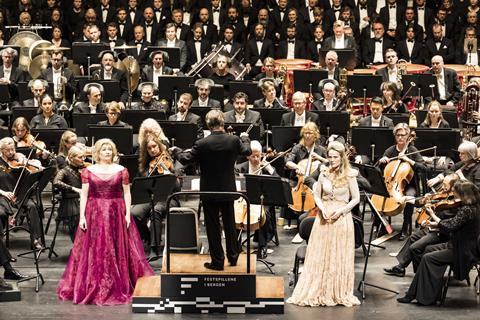
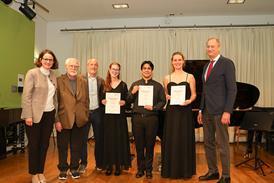
Griegshallen also provided the space for informal drop-in concerts during the day, where students from the Grieg Academy presented chamber music performances at the venue’s foyer throughout the festival. I could see that these short sessions were invaluable performance opportunities for the students, who had the chance to speak to the audience and perform in front of friendly faces – many of whom were fellow students, there to support their peers.
My time at the festival illustrated the range of artistic performances on offer, of which I only saw a tiny taster. While not particularly part of The Strad’s traditional remit, it was a treat to watch a tribute to jazz legend Miles Davis’s 100th anniversary with some of Norway’s finest jazz musicians, accompanied by the Norwegian Radio Orchestra. The transformed industrial space of Hallen USF provided a casual, standing-room-only venue, where audience members could groove while enjoying a drink and some street food throughout the performance.
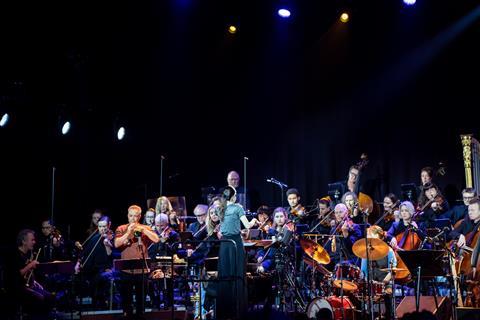
Overall, the Bergen International Festival presented a wide-ranging programme that highlighted both international and Norwegian artists across a variety of venues and formats. From large-scale orchestral works and reimagined Baroque repertoire to traditional Hardanger music and contemporary jazz, the festival illustrated diversity in both performance style and setting. The combination of formal concerts, informal drop-in events and outdoor performances created a dynamic atmosphere, offering audiences multiple ways to engage with the city’s cultural life – despite Bergen’s ever-present rain.
Read: Istem: expanding the voice of the Hardanger tradition
Read: How I won my job at the San Francisco Symphony, aged 18
Read more Featured Stories like this in The Strad Playing Hub












No comments yet