







Uniting violin, viola and cello variants of the Hardanger instrument, the Norwegian group Istem is carving out new repertoire for an ensemble rarely heard on concert stages. Davina Shum spoke to the members at the Bergen International Festival
Read more Featured Stories like this in The Strad Playing Hub
When thinking of traditional Norwegian instruments, the Hardanger fiddle often comes to mind, celebrated for its richly ornate design and resonant sympathetic strings. But what about its lesser-known relatives - the viola and cello counterparts?
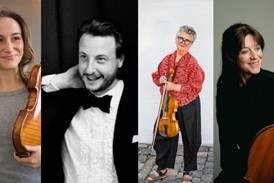
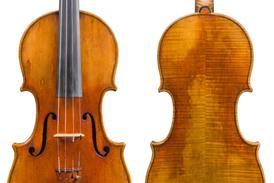
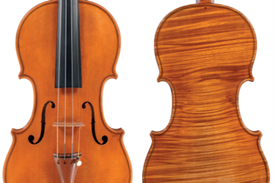
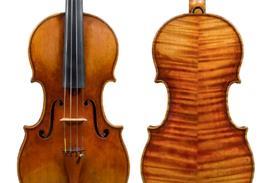
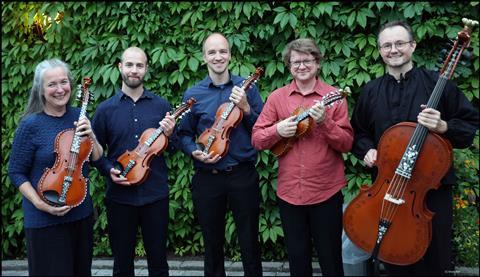
While the Hardanger fiddle has existed for centuries, the Hardanger viola and cello are relatively new to the public eye. Bringing these instruments together is the Norwegian ensemble Istem, which presents new compositions and arrangements written specifically for this distinctive family of instruments.
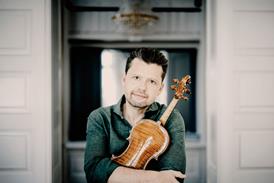
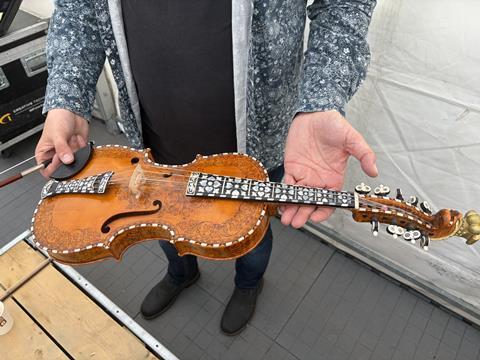
Vegar Vårdal serves as the group’s leader and composer, creating works and arrangements of traditional Hardanger fiddle tunes that bridge folk music and chamber music. This new repertoire aims to serve the instruments of the ensemble, which were built by musician and instrument maker, Ottar Kåsa.
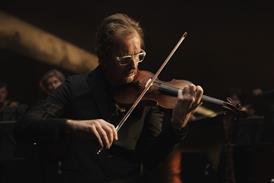
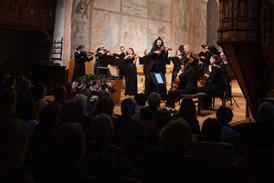
I spoke with Vårdal, Kåsa and cellist Johannes Martens after Istem performed a short outdoor set at the main festival square on Torgallmenningen in central Bergen, during this year’s Bergen International Festival (held from 27 May to 10 June). The ensemble – which also comprises Sivert Holmen on Hardanger fiddle and Nora Taksdal on Hardanger viola – played under shelter, while audience members looked on from nearby chairs in raincoats or huddled beneath umbrellas. After all, Bergen is widely regarded as Europe’s rainiest city, with around 240 days of rainfall each year.
The fiddlers switched between other instruments onstage, due to the different tunings that were required from the pieces. While tuning varies, the instruments are largely tuned with a combination of 4ths and 5ths. Martens, who is also a cellist in the Oslo Philharmonic, tunes his five-stringed cello to F#-B-E-B-E. Does that get confusing with conventional tuning? Yes, he says, but attributes his success on the Hardanger cello to previous experience playing the viola da gamba.
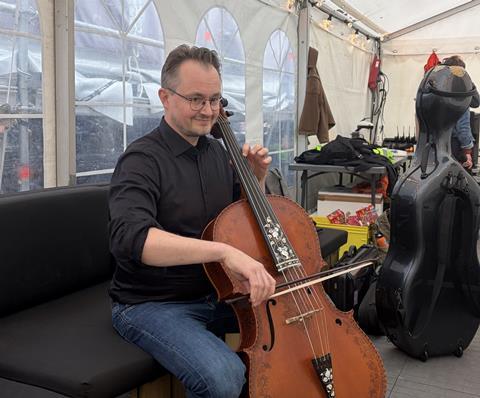
Kåsa began building Hardanger instruments in 2005. He got the idea to make a Hardanger viola as a birthday gift for Taksdal around six years ago.
‘It seems there are a lot of players who are interested in the sound of the Hardanger instruments,’ Kåsa says. ‘It opens up new sound landscapes.’
His foundation may be based on his study of Stradivari and Guarneri instruments, but many of the dimensions of the Hardanger instruments are different, such as the soundpost lengths, a flatter fingerboard much like a baroque instrument, and shorter, thicker necks. However, it provides a canvas for his creativity, with each instrument decorated with mother-of-pearl and ebony inlays, and free-hand drawn patterns.
Listening to the Hardanger instruments, their distinctive sound seems constant, clear-toned, with an extensive use of drones. As a player, how does one create this sound?
‘You have to use the bow quite differently on the Hardanger fiddle than with a normal violin,’ says Vårdal. He describes the sound being produced from the motion of the bow arm. With the gut strings, it’s like approaching a baroque instrument – you can’t articulate with force, as it will crush the sound.
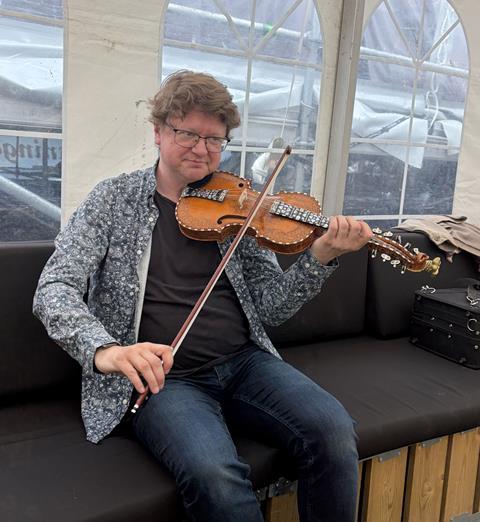
Vårdal acknowledges that there is not much music for the lower-end Hardanger instruments, so has arranged existing Hardanger fiddle music to include these. The ensemble’s programme at Edvard Grieg’s home in Troldhaugen comprises new tunes by Vårdal for each of his ensemble mates to take the spotlight with their own interpretations and even chances to improvise. Additionally, the tunes will platform traditional music from Telemark, an area in eastern Norway.
As well as expanding the repertoire for Hardanger ensemble, Vårdal hopes to circulate it beyond Norway, by sharing his arrangements.
‘[I hope that] people will play this music around the world.’
Read: Norwegian Wood: The history of the Hardanger fiddle
Read: Postcard from Norway: Bergen International Festival
Read more Featured Stories like this in The Strad Playing Hub











No comments yet