







Composer Kian Ravaei reflects on writing The Four Seasons of Hamadan, a new work for violin and dancer that intertwines Persian and Jewish traditions
Read more Featured Stories like this in The Strad Playing Hub
Any child of immigrants – in my case, Iranian immigrants in Los Angeles – understands the experience of being wedged between two cultures. In my music, I combine Iranian and Western classical styles to grapple with this duality, creating a fusion that reflects my Iranian-American identity. Western classical music, for all its richness, merely scratches the surface of the diverse human experiences that music can articulate. But when it enters into dialogue with other global traditions, we glimpse the complexities of our interconnected humanity.
To transcend the cultural boundaries of my musical practice, I embarked on a collaboration with Annie Kahane, a close friend and choreographer of Jewish descent. We spent a year immersed in each other’s cultural idioms – the Jewish klezmer music of her heritage, and the Persian folk dance of mine – then came together to create a piece that honours our respective backgrounds while illuminating their surprising intersections.
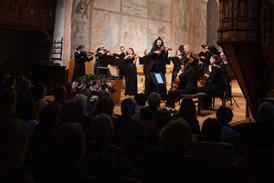
The result was a 23-minute duet for violin and dancer where each movement – Spring, Summer, Autumn, and Winter – draws inspiration from Persian and Jewish seasonal rituals. We called it The Four Seasons of Hamadan, after the city in modern-day Iran where Esther and Mordecai, figures from the Hebrew bible, are believed to be entombed.
I was deeply fortunate to spend my year of Jewish music study with Sherry Mayrent, a formidable klezmer clarinetist and prolific composer of klezmer tunes. She is also the namesake of the Mayrent Institute for Yiddish Culture at the University of Wisconsin-Madison, which houses thousands of historical Jewish music recordings from her personal record collection.
These recordings introduced me to countless luminaries of early twentieth-century Jewish music. I fell in love with the soulful clarinets of Dave Tarras and Naftule Brandwein. I marveled at the virtuosic passagework of xylophonist Jacob Hoffman. I sang along with folk singers and cantors alike, from Pepi Litman to Josef Rosenblatt, trying my best to internalise their styles.
Learning a new musical language offered profound revelations, but it also came with growing pains. Once, when discussing harmony in klezmer music, I referred to D minor and G minor as the ‘one’ chord and the ‘four’ chord, employing the system of Roman numerals I learnt from Western music theory textbooks. Sherry cautioned me against the reflex of using a theoretical framework that was never intended for analyzing klezmer music, even if it aided my short-term understanding. Instead, she encouraged me to put aside my preexisting knowledge and listen to the music on its own terms, humbly embracing a beginner’s mindset.
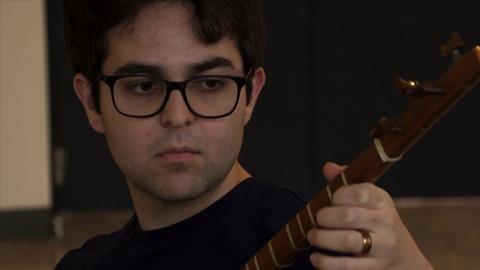
During my immersion in Jewish music, I simultaneously deepened my knowledge of Iranian music by taking lessons in a traditional plucked string instrument called the setār. My ostād (‘masterful teacher’ in Persian) was Fariborz Azizi, who taught me from the method book of his own ostād Hossein Alizadeh, one of Iran’s foremost musicians.
Even in the familiar confines of my own culture, I struggled to surrender my Western ways of thinking. During one of my first lessons, Fariborz recorded a short piece and instructed me to memorize it by imitating him. Learning by ear exhausted my patience, so instead, I located the piece in the method book and memorised the music notation. When I played the piece for Fariborz, his ears perked up, recognising that I had cut corners.
’In Persian music,’ he explained, ’it is not about what you play; it is about how you play it.’ My interpretation lacked specific nuances of timbre, ornamentation, and microrhythm, passed down orally by generations of Persian musicians, that Western notation cannot capture.
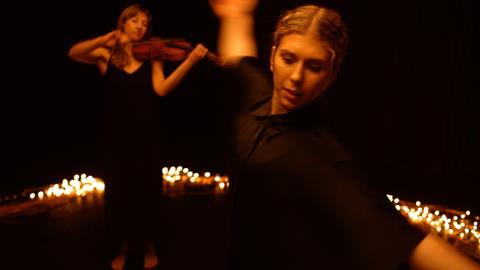
The central challenge of composing The Four Seasons of Hamadan was to create a true synergy between Persian and Jewish music: one that allows their disparate elements to converge without obscuring the singular beauty of either tradition. Each movement addresses this challenge in its own way. For example, the final movement, ’Winter: Yalda & Hannukah,’ begins with an eight-chord cycle that alludes to the infamous D minor Chaconne from Bach’s second Violin Partita, a familiar piece to every conservatory-trained violinist.
These chords become the foundation for a set of variations, alternating between passionate klezmer inflections and florid setār-like gestures, showing that Jewish and Persian idioms can achieve more than mere coexistence: they can fuse into a third kind of music that transcends the sum of its parts. Annie’s choreography reinforces this point, effortlessly interweaving Persian and Jewish dance forms.
When Annie and I first conceived of this project in 2022, we could not have envisioned the political resonance it would carry by the time of its 2025 premiere. Our message of intercultural harmony, however, is the same now as it was then. Cultural curiosity is a powerful and disarming response to a world wreaked by global conflict and political division.
If there is one urgent takeaway from The Four Seasons of Hamadan, it is that approaching another’s culture with reverence will open your heart to untold worlds of beauty, delight, and creative possibility.
Listen to The Four Seasons of Hamadan here:
Read: ‘Make it enjoyable to play’: violinist Irvine Arditti on the music of Roger Reynolds
Read more Featured Stories like this in The Strad Playing Hub












No comments yet