

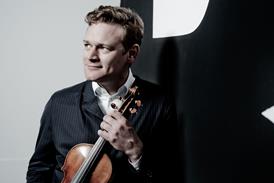


From discovering the score as a student to recording the work decades later, violinist Darragh Morgan traces his long relationship with Philip Glass’s strikingly original 1968 composition for solo violin

Read more Featured Stories like this in The Strad Playing Hub
Strung Out by Philip Glass for amplified solo violin came into being in a world long before iPads and foot pedals were used for turning the pages of a musical score. It is eight pages long with a complete da capo repeat, and there is nowhere for the performer to turn pages. It was first performed in September 1968 by Dorothy Pixley-Rothschild in Philip Glass’s debut New York concert. In this performance the music was taped onto the wall, creating a spatial as well as musical composition in which the violinist moves throughout the performance space. The work derives its title from this arrangement of the score – which is literally ‘strung out’ around the performance space and determines the performer’s trajectory.
My first introduction to Strung Out was in the library of the Guildhall School of Music and Drama, while I was studying there in the early 1990s, alongside another work from 1967, Head On for piano trio. I was just beginning to learn about (and become fascinated by) system/minimalist music and I recognised a direct correlation between these two early compositions, as well as being hugely enamoured of the visual attractiveness of Philip Glass’s own penmanship.
Twenty years later, when I was violinist with the Smith Quartet from 2006–11, we performed and recorded Glass’s complete string quartets (at the time nos 1–5) touring the USA, Europe and Asia. This work deepened my understanding of the demands of this particular musical language. Building the stamina to perform large-scale minimalist works taught me that my approach to the string sound should be one of almost sterile cleanliness, devoid of any traditional stylisation. I found that too many expressive inflections interrupted the flow of the musical line. Paradoxically, the music requires both restraint and a vibrant, focused and clear quality of string tone.

When Orange Mountain Music invited me to record Strung Out, it felt like a chance to return to a work that had fascinated me since my student days. An earlier recording of Head On with the Fidelio Trio had already brought me closer to Glass’s early compositional processes, making Strung Out a natural next step.
Another important influence that completes the thread of the story is conductor and violinist Paul Zukofsky, whose own long association with Philip Glass included performing the premiere of the Violin Concerto no.1 in 1987 as well as recording the violin title role for the 1978 release of Einstein on the Beach. We first met in the 1990s at the Britten-Pears School for Advanced Musical Studies where I was his orchestral leader for performances at the Aldeburgh Festival.
Knowing that Zukowsky had been intricately involved in these projects was a real ‘wow factor’ and had a huge impact on me. His insights into this repertoire left a lasting impression and it feels particularly fitting that my new recording of Strung Out was supported by Musical Observations, the non-profit musical organisation established in his name.
Nearly six decades after its premiere, Strung Out remains a striking example of Glass’s early style: visually imaginative, physically demanding and demonstrating the additive processes and structures that shaped much of his later music. Recording it for the Orange Mountain Music label offered me an opportunity to revisit a work that has accompanied my musical life for more than 30 years.
Read: Reaching for the stars: Ethan Jankowski on creating a celestial sound galaxy for strings
Read: Bella Hristova on ‘Lineage’: commissioning six new works for solo violin
Read more Featured Stories like this in The Strad Playing Hub







No comments yet