






What connects Bach, Ysaÿe and the composers of today? Violinist Bella Hristova shares her thoughts behind her latest project Lineage, which pays tribute to history’s violin masterpieces through six new commissions
Read more Featured Stories like this in The Strad Playing Hub
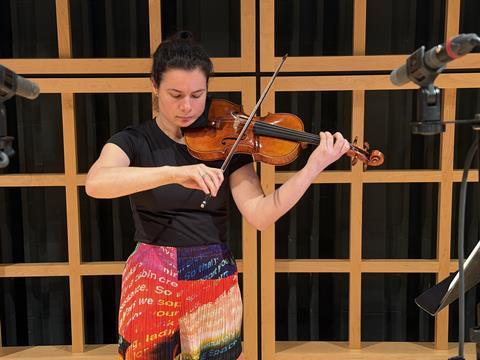
If I had to choose one piece to practise for the rest of my life, it would be Bach’s Chaconne. I have long been drawn to the solo violin repertoire, and I think that’s in part because my favourite instrument is actually the piano. When I play unaccompanied violin music, it’s as close as I can get to being a pianist.
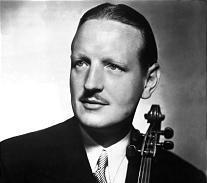
The inspiration for my commissioning project Lineage goes back to my time at Indiana University, when I studied Eugène Ysaÿe’s six sonatas with my mentor, Jaime Laredo. Through Jaime, whose own teacher Josef Gingold had studied with Ysaÿe, I felt a direct connection to the composer. Jaime spoke about Ysaÿe’s deep admiration for Bach, and how Bach’s Sonatas and Partitas inspired him to create his own six sonatas – not mere showpieces, but substantial works written in the musical language of his time. That idea stayed with me and eventually inspired this project: to reimagine the lineage of unaccompanied violin music in the 21st century, while celebrating the rich history of writing for solo violin.
No matter how much I love the Chaconne, I can’t call up Bach and ask what exactly he meant by that one marking. That’s just one of the reasons I love working with living composers, and I feel it’s my responsibility as an artist to expand the violin repertoire by bringing new music into the world. So I decided to commission six composers, giving each of them the same broad prompt: to engage in some way with the solo violin tradition established by Bach and transformed by Ysaÿe. I deliberately left open how they interpreted that – inviting each composer to bring her own voice and personal connection to the violin.

The project began in 2015, and from the outset I knew it would unfold over many years. It was important to me to commission composers at different stages of their careers. I began with Joan Tower, whose String Force I had already performed and admired. Nokuthula Ngwenyama followed several years later, then Ellen Taaffe Zwilich – all composers I had wanted to work with.
I realised that the composers I was gravitating toward were all women, and decided to embrace that as the project continued. This led me to commission Gloria Kravchenko, Eunike Tanzil, and Dai Wei – composers representing a younger generation, each of whose work had already made a strong impression on me. The title Lineage itself only came to me halfway through the process, once I realised how many different meanings that idea had taken on within the project.
Joan’s Second String Force immediately set the stage for uncompromising virtuosity, using extreme contrasts and stratospheric writing to stretch the outer limits of the instrument. Thula’s Miasma, written during the pandemic, is built around a unique concept: each of the fast sections incorporates letters from the Covid-19 genome, tying the work directly to a moment in recent history.
Ellen took the project in a very personal direction. After learning that my father, a Soviet-era composer, had written many songs for children, she began thinking about the lasting impression music and books leave on us in childhood, and drew on that while writing Carousel.
Gloria, a 17-year-old Ukrainian composer, wrote the beautifully evocative Woman in a Field of Stover, a three-movement work that slowly comes into focus and ultimately comes to rest in delicate harmonics, with a remarkable range of expression in between. (I will admit I had to look up the word ’stover’ – the dried stalks and leaves left in a field after harvest.)
Eunike likewise chose a three-movement structure in her Rule of Three, where each movement takes on a distinct character – from ‘Roots,’ drawing on her Indonesian heritage, to a playful ragtime-inspired second movement, ending with a high-energy finale titled ‘Rush’.
Dai Wei’s Weighless is relentless and propulsive, almost rock-and-roll in character, with a distinctive physicality throughout. Wei later told me she had imagined my marathon training while writing, and the piece captures exactly that sense of endurance and constant forward momentum, even in its quietest moments.
It was always my intention to make an album of the commissions, which I recorded in June 2026. In the months leading up to the recording, I deliberately set aside a significant amount of time to immerse myself in these six works. Solutions to technical and musical problems often came to me away from the violin – and frequently while running, when my brain finally had the space to process what I had worked on earlier that day. Ahead of the sessions, I carefully planned which pieces I would record on which days, balancing their different physical demands in order to sustain long hours of repetition without wearing myself out.
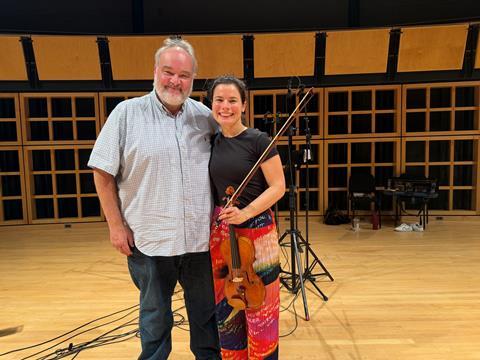
The recording process itself requires enormous stamina, focus, and the ability to repeat small sections over and over while maintaining the same level of conviction every time. Working with producer Alan Bise was a great joy – his extraordinary ears and impeccable attention to detail made him the ideal partner for capturing a project of this scope. There was something incredibly satisfying about standing alone on stage surrounded by microphones and working through all six pieces over the course of three days, after spending eleven years building the project one commission at a time. Lineage will be released by Azica Records in the spring of 2027, marking an important milestone in a project that has shaped so much of my artistic life over the last decade.
From the very beginning, a central part of this project has been the desire to contribute something meaningful to the ever-evolving solo violin repertoire. As Bach inspired Ysaÿe, and Ysaÿe’s response inspired the Lineage commissions, I can only hope these six new works continue to inspire future generations of violinists.
Read: Bella Hristova: Milestones with Jaime Laredo at Carnegie Hall
Read: ‘Classical music needs a new why’: Vijay Gupta on his memoir ‘Restrung’
Read more Featured Stories like this in The Strad Playing Hub











No comments yet