









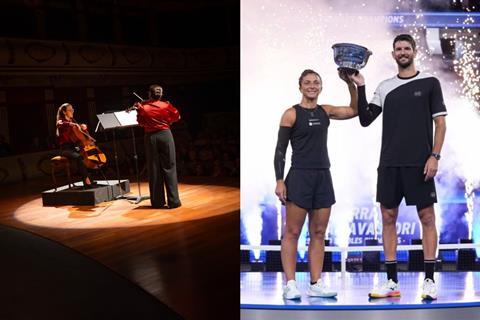
Sara Errani and Andrea Vavassori lifted the trophy at the US Open’s revamped mixed doubles tournament on Wednesday night, showcasing the best of their team player skills not unlike those required in chamber music. Cellist Davina Shum (and The Strad’s resident tennis nut) examines what musicians can learn from these specialist doubles players
Discover more Featured Stories like this in The Strad Playing Hub
Here is some background information for anyone not in the know: the US Open Championships, which is the last of four Grand Slam tournaments in the tennis calendar, has this year introduced the inaugural ‘reimagined’ mixed doubles tournament. It was seen as an attempt to drive viewers to engage with the traditionally lesser-watched doubles matches, by presenting a star-studded line up of mostly singles players teaming up in scratch pairings. There’s been much hype in the tennis world of seeing star players take to the court together, putting both male and female players in an environment not often seen.
Entry requirements for the tournaments heavily favoured singles players, with players gaining entry based on their combined singles rankings. This caused consternation among specialised doubles players who felt sidelined by these criteria, many of whom have a low singles ranking or no singles ranking at all, instead relying on a rare wildcard to gain entry.
So it’s almost poetic that of the 16 teams that participated in this mixed doubles tournament - which took place on 19 and 20 August in the US Open’s Fan Week – was won by the only dedicated specialised doubles team that featured on the draw, comprising Italians Sara Errani and Andrea Vavassori.
In the final, they played six-time Grand Slam winner Iga Swiatek, hot off her recent victories at Wimbledon and Cincinnati (the latter of which she only attained on Monday evening) and three-time major finalist Casper Ruud. Errani and Vavassori, while their singles accolades may pale in comparison to the aforementioned, were the defending champions of the US Open mixed doubles title, and added the French Open title to their combined cabinet collection earlier this summer.
So what happens when you pit a dedicated team against a scratch pairing? In this instance, the specialists emerged victorious over the singles players, citing it as a victory for doubles players that couldn’t play in the tournament. It was evident that they were an ensemble of established status, communicating almost telepathically, anticipating the other player’s movements and playing tactically, in order to set up winning shots that clinched them the title 10-6 in the deciding third-set tiebreak.
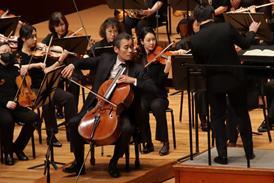
In a comparison with the string-playing world, it would be like hearing the difference between a long-standing, established ensemble, and one comprising of virtuosic, brilliant soloists, put together at the last minute. While the latter may be technically dazzling, flashy and entertaining, there could be an element of slight chaos with players being in a situation of playing with someone unfamiliar (semi-finalist Jessica Pegula joked that she and her partner Jack Draper had said four words to each other before they played together). Don’t get me wrong, slight chaos and spontaneity can make for great music making at times – it’s an opportunity for performers to really pull up their socks and play with heightened focus when the stakes really matter.
But it’s different from playing chamber music with familiar peers. In such a situation, rehearsals can feel seamless, with unique communication between players – sometimes all it takes is a slight tweak of the eyebrow or a certain head gesture to indicate a crucial turning point, tempo change, or harmonic arrival that can make a performance heart-wrenchingly poignant.
Like any good team, Errani and Vavassori planned their performance tactically, studying the playing patterns of their opponents and talking a lot about team dynamics off the court. In defeat, Swiatek said: ‘I guess you proved doubles players are smarter tactically than singles players,’ in her post-match speech congratulating the winners.
So what can we learn from this established duo? That in chamber music, the skills of communication, collaboration and preparation are crucial to bring together moving parts successfully and create a cohesive performance. In your next chamber performance, be more like Errani and Vavassori. Forza!
Read: String tension? Tennis player Novak Djokovic and violin appear in a new Asics ad
Read: The Good Bad Day: how to play on days that aren’t your best
Discover more Featured Stories like this in The Strad Playing Hub
The number one source for playing and teaching books, guides, CDs, calendars and back issues of the magazine.
In The Best of Technique you’ll discover the top playing tips of the world’s leading string players and teachers. It’s packed full of exercises for students, plus examples from the standard repertoire to show you how to integrate the technique into your playing.
In the second volume of The Strad’s Masterclass series, soloists including James Ehnes, Jennifer Koh, Philippe Graffin, Daniel Hope and Arabella Steinbacher give their thoughts on some of the greatest works in the string repertoire. Each has annotated the sheet music with their own bowings, fingerings and comments.
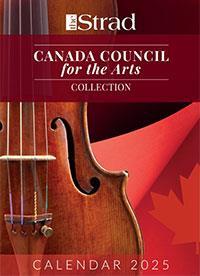
The Canada Council of the Arts’ Musical Instrument Bank is 40 years old in 2025. This year’s calendar celebrates some its treasures, including four instruments by Antonio Stradivari and priceless works by Montagnana, Gagliano, Pressenda and David Tecchler.












No comments yet