






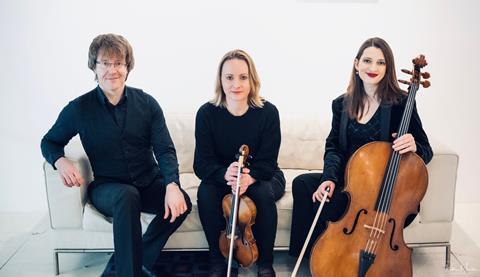
With the release of the Rautio Trio’s latest Beethoven album, violinist Jane Gordon explores how her holistic approach to playing has helped her embrace creativity when recording with fortepiano
Read more Featured Stories like this in The Strad Playing Hub
There are moments in performance when everything comes together so completely that the atmosphere in the concert hall shifts and becomes electric. Time appears to stand still, the audience is utterly absorbed, and there is an extraordinary feeling that the music is simply unfolding by itself. Many performers recognise this as the ‘flow state’ - those rare moments when musical intention and physical execution become one. The audience plays its part too.
From a player’s perspective there are no nerves, no overthinking and no sense of consciously managing every technical detail. Instead, there is complete sense of freedom. The shape of a phrase seems to emerge effortlessly, and there is a direct connection between musical thought and sound. It is an incredible feeling and, for many performers, something we spend our careers trying to recreate.
Ironically, modern performance often makes this increasingly difficult. Concerts are now frequently filmed for streaming, social media or live broadcasts, and the presence of microphones can subtly alter our mindset. Instead of communicating freely, we become aware of being documented. In the recording studio, this can become even more pronounced. The pursuit of perfection encourages conscious control, making it easy to overthink and, in turn, create unnecessary physical tension. We begin micromanaging individual notes and phrases rather than experiencing the larger musical architecture.
Just over a decade ago I trained as an Alexander Technique teacher, an experience that fundamentally changed my approach to playing. My violin training was rigorous, but I had paid little attention to the way I was using my body as a whole while I played, or to what that might reveal about the way I prepared for performance. I began questioning how I was thinking while I played. This was a catalyst for developing a holistic approach, which gradually shifted my priorities.
I also read The Inner Game of Tennis by Timothy Gallwey, and became curious about parallels between music with sports psychology. Rather than trying to control every aspect of playing, I became more interested in creating the conditions in which music could emerge naturally. Central to that was a conscious letting go of ‘trying too hard’ in playing and instead finding a sense of ease. From this place creativity feels uninhibited.
Rather than trying to control every aspect of playing, I became more interested in creating the conditions in which music could emerge naturally
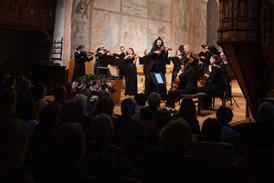
Recording the complete Beethoven Piano Trios with the Rautio Trio has been a monumental project, one that has tested me and pushed me to work even harder artistically. Our recording style as a trio has evolved and with this latest album, volume 3 (of 4), we consciously recorded in much broader takes, to preserve the sense of performance and flow.
Performing this repertoire with a fortepiano brings considerable challenges. Almost every phrase has to be reconsidered as the fundamental balance and sound world of the ensemble has shifted. A melody that projects naturally with a modern piano requires a completely different approach. Accompanying figures need new articulation and balance, unison passages with the cello demand a different blend of sound, and intonation at A = 430Hz, together with the temperament of the instrument, creates a level of exposure that requires constant scrutiny. All of this work demands detailed, conscious thought and an openness to abandoning long-established assumptions about the music.
During the recording sessions, I didn’t want to be thinking about balance, bow distribution or tuning systems. I wanted to return to the freedom that first drew me to the music. The process is to do enough detailed work beforehand that, when the red light comes on, musical instinct can take over. Some of my most memorable moments during the recording sessions came after many hours of concentrated work.
Although physically tired, there were occasions when I felt completely energised and in the zone. The music seemed to flow effortlessly and, despite the microphones surrounding us, we found ourselves completely absorbed in the music, with the recording process fading into the background.
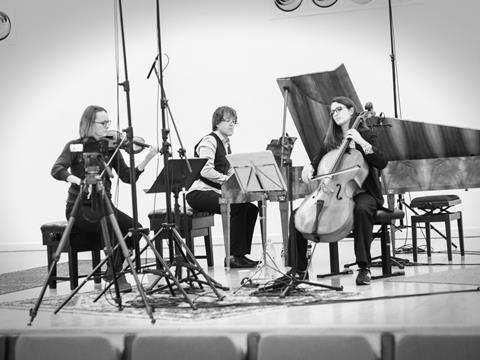
Being in the flow state as a performer happens most readily when there is an audience to connect with. Musical performance is, after all, an act of communication, and an attentive audience responds to the expression and energy of a performance in a way that feeds back to the players. It’s a feeling recognised by everyone in the hall and sensed through the atmosphere, often in moments of complete silence, as though the audience is collectively holding its breath.
In the recording studio we have to recreate that same sense of communication without anyone physically present. Our focus becomes bringing Beethoven’s music to life as vividly as possible to our imagined audience. In the moment, our attention shifts entirely away from ourselves and towards communicating the music. The intensity of concentration, commitment and shared purpose this demands draws every part of us into the performance. I trust the resulting expression is something listeners can hear.
Looking back, recording Beethoven on fortepiano has reinforced something I knew intellectually but was still seeking tangibly. Technique remains essential, but it was never the destination. All the analytical work, whether technical practice, ensemble rehearsal or careful consideration of historical instruments, exists to serve something greater than the sum of these parts combined: genuine creativity.
Perhaps that is what holistic practice has ultimately given me. Not a different technique, but a greater trust in the musical imagination. The more thoroughly I prepare, the more willing I can be to let go, quieten the inner critic and simply play. In the end, beyond all the precision, that heightened experience of flow remains the real goal.
The Rautio Trio’s album of Beethoven Piano Trios is out now on Resonus.


![Ayanna Witter-Johnson [Jordan Woods] 7](https://dnan0fzjxntrj.cloudfront.net/Pictures/100x67/4/9/4/44494_ayannawitterjohnsonjordanwoods7_224583.jpg)






No comments yet