
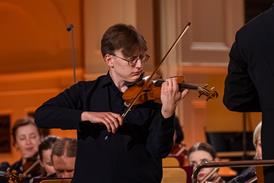
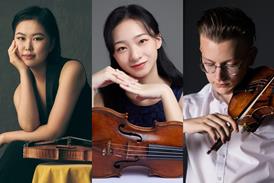

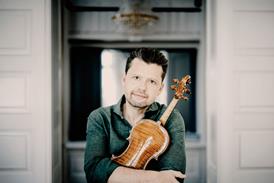
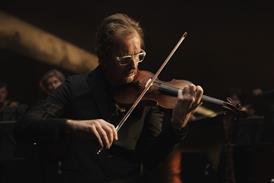



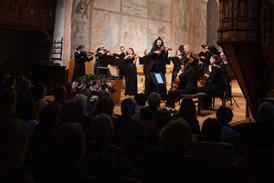



On its new album Edge of the Storm, the US-American Telegraph Quartet explores string quartets born of war, exile and renewal.
Discover more Featured Stories like this in The Strad Playing Hub
Edge of the Storm, the new album by the Telegraph Quartet, is the second instalment in its ongoing 20th-Century Vantage Points series – a curatorial project that maps key string quartet works against the seismic historical forces of the last century. Where the first volume (Divergent Paths, 2023) explored the early modernist rupture through Ravel and Schoenberg, this new release turns to the years 1941–1951: a turbulent decade shaped by war, exile, and the search for renewal.
On the surface, the three featured composers – Grażyna Bacewicz, Benjamin Britten, and Mieczysław Weinberg – share little stylistically. But as the Telegraph Quartet makes clear, their respective quartets are united by the moral and emotional reckonings that shadowed mid-century life.
Bacewicz’s Fourth Quartet, written in the hopeful if haunted aftermath of the war, reflects her time as part of the Polish musical resistance. Britten’s First Quartet, composed during his wartime exile in the United States, captures a sense of aesthetic reorientation. Weinberg’s Sixth Quartet, by contrast, is an unflinching response to personal and collective trauma – its long suppression by Soviet authorities lending added urgency to its performance today.
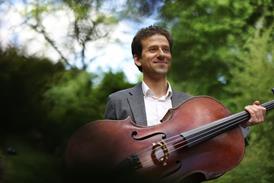
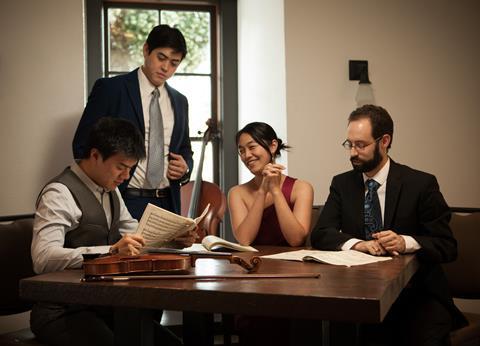
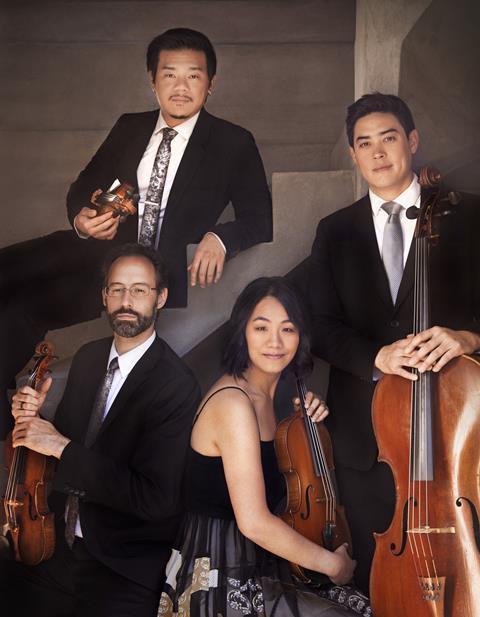
Recorded with producer Alan Bise for Azica Records and featuring cover art by Kandinsky, Edge of the Storm builds on the Telegraph’s reputation for intellectually searching and emotionally charged interpretations. Now quartet-in-residence with the University of Michigan, the ensemble – violinists Eric Chin and Joseph Maile, violist Pei-Ling Lin, and cellist Jeremiah Shaw – approaches this music not simply as historical document, but as a living challenge to engage with the past.
In this conversation with US correspondent Thomas May, all four Telegraph musicians reflect on uncovering buried voices, building narrative through repertoire and the evolving role of performers as stewards of musical memory.
This is the second instalment in your 20th-Century Vantage Points series. What draws you back to this century again and again, and how do you see your role as performers in reframing its musical legacy?
Joseph Maile: The music of the 20th century has always spoken to our aesthetic and part of that is maybe due to the explosion of variety, sonic innovation, and emotional depth that occurred over the 20th century. Often when audiences talk about ’modern music’ of that time, there is the suspicion of something esoteric or cold and yet we’ve found that couldn’t be farther from the truth - only that the emotions are modern in their intensity and extremes while timeless in their substance. That is how we see our role with these works: to amplify to audiences the humanity that already lives deeply in them.

Edge of the Storm spans three quartets composed between 1941 and 1951 – years marked by trauma and displacement but also redefinition. How did you shape this repertoire into a cohesive narrative? How much did historical context guide your interpretive choices?
Eric Chin: With Edge of the Storm, we weren’t aiming to create a single linear arc, but rather a collection of experiences from across the globe shaped by the cataclysm of World War II. Britten’s, written in wartime America, glows with luminous anticipation, releasing its tension in flashes of optimistic brilliance. Bacewicz’s postwar work gives vibrant, folk-infused rhythms and sound worlds, reminding us of cultural roots amid renewal. Weinberg’s, composed in Moscow in the War’s immediate aftermath, moves between haunting lyricism and fiery defiance, culminating in a final movement of the piece and our album in a celebration of fully unbridled identity. Together, these works speak with distinct voices yet share an unshakable spirit of resilience, identity, and hope in the face of extraordinary global conflict.
Historical context was very important, not so much in interpreting a particular note or a phrase, but more for us to have a better chance at grasping where each composer was coming from emotionally.
We were aiming to create a collection of experiences from across the globe shaped by the cataclysm of World War II
Weinberg’s Sixth Quartet is a harrowing work and remained unperformed for 60 years. Can you share insights from your coaching sessions with Gilles Millet of Quatuor Danel, who helped revive it – and how those conversations shaped your interpretation?
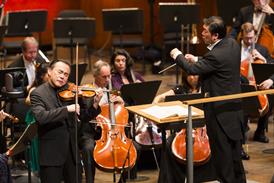
Joseph Maile: Gilles was an incredible force to work with and I remember being exhausted at the end of sessions with him after the intensity he asked for this piece. We’re used to being pretty high energy but his coachings on this work fondly reminded me of similar sessions we had with some of our past mentors, particularly Mark Sokol and Ian Swensen in how he convinced us how much more emotion we could give.
Certainly Gilles’ intimacy with this work and with Weinberg’s family shaped countless specific decisions he passed on to us but I think most of all his ardent advocacy of this relatively unknown composer was as powerful of a message as those specific interpretations. That is an advocacy I do feel we’ve tried very hard to represent whenever we perform it.
Britten’s First Quartet is a product of his American sojourn. How does it reflect the composer’s personal and artistic transition? Are there aspects that feel uniquely ’transatlantic’ to you as performers?
Jeremiah Shaw: This quartet was commissioned by Elizabeth Sprague Coolidge in 1941, and composed in California after leaving England for pacifist reasons. America offered him not only artistic refuge but also personal freedom – especially in his relationship with tenor Peter Pears, which had to remain discreet in Britain due to anti-homosexuality laws. That duality – freedom and distance, intimacy and alienation – is embedded in the music.
The quartet opens with ethereal chords above a grounded cello line, evoking the vastness of the Pacific coast. You can hear the ocean’s tide and shimmering light in the textures. The Allegretto has the British charm and wit, while the finale’s syncopated energy nods to American jazz. It’s a remarkable turning point – a work of emotional maturity born of artistic exile and personal transformation.
Bacewicz’s Fourth Quartet is a remarkable example of artistic renewal amid ruin. What did you discover about her compositional voice in this piece? How does it contrast with the more familiar idioms of Britten and Weinberg?
Pei-Ling Lin: I would describe her writing as very witty and unpredictable yet personal. There is also an incredible thrust in the way she wrote her phrases that you feel when it’s played to the music’s potential – it’s like driving a car with quick acceleration.
Your 20th-Century Vantage Points series frames repertoire through historical windows rather than stylistic schools. How has that lens influenced the way you approach programming – and how do you think it changes the listening experience?
Pei-Ling Lin: It comes down to one of the reasons this period of music is fascinating to us. The artistic response to the turmoil in history while in different languages, aesthetics, colours and forms, you hear the common thread of emotion such as struggle, mourning, strength, brilliance and hopefulness. This thread of emotions resonates with us so deeply that we are inspired to convey the same spirits in all our programmes.
What kinds of responses or conversations do you hope Edge of the Storm might spark – particularly among listeners with personal or familial ties to the war years?
Eric Chin: We certainly hope it sparks conversations, especially between those who lived through the war and those who either weren’t alive or weren’t directly affected by it. For many of us today, World War II can feel almost like a story rather than something that truly happened. With this album, we hope to offer a tangible emotional connection to pair with the historical record, so the music becomes a bridge between knowledge and feeling. The deeper that understanding, the better we can move forward and the less likely we are to allow history to repeat itself.
Edge of the Storm releases on Azica Records on 22 August 2025.
Read: Telegraph Quartet: Divergent Paths
Read: The Telegraph Quartet on performing live to a classic Buster Keaton silent film
Read: Telegraph Quartet to take up residency at the University of Michigan
Discover more Featured Stories like this in The Strad Playing Hub
The number one source for playing and teaching books, guides, CDs, calendars and back issues of the magazine.
In The Best of Technique you’ll discover the top playing tips of the world’s leading string players and teachers. It’s packed full of exercises for students, plus examples from the standard repertoire to show you how to integrate the technique into your playing.
In the second volume of The Strad’s Masterclass series, soloists including James Ehnes, Jennifer Koh, Philippe Graffin, Daniel Hope and Arabella Steinbacher give their thoughts on some of the greatest works in the string repertoire. Each has annotated the sheet music with their own bowings, fingerings and comments.
The Canada Council of the Arts’ Musical Instrument Bank is 40 years old in 2025. This year’s calendar celebrates some its treasures, including four instruments by Antonio Stradivari and priceless works by Montagnana, Gagliano, Pressenda and David Tecchler.










No comments yet