


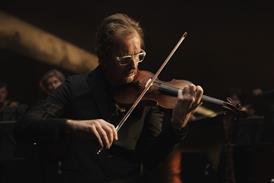









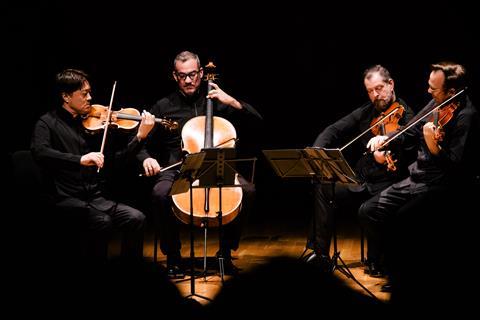
The Miró Quartet brings decades of commitment to its new recording of the complete string quartets of Argentine composer Alberto Ginastera.
Discover more Featured Stories like this in The Strad Playing Hub
Among the Miró Quartet’s projects marking its milestone 30th-anniversary season in 2025 is a new recording of the three string quartets by Alberto Ginastera. For the String Quartet No. 3, Miró is joined by soprano Kiera Duffy. Long a staple of the ensemble’s live repertoire, these works trace the full arc of the Argentine composer’s creative evolution. As violist John Largess notes, they synthesise Argentine folk idioms with bold modernist language, making extraordinary technical demands.
Known for immersive storytelling in projects such as its complete Beethoven cycle and the recent conceptual album Home, Miró approaches Ginastera’s quartets as a powerful narrative cycle – distinct yet deeply interconnected.
Largess spoke with US correspondent Thomas May about the long journey behind this project and the Miró’s firm commitment to the value of Ginastera’s music and why these works deserve a central place in the repertoire.
Why did you choose Ginastera’s string quartets to mark this milestone – and why now?
John Largess: The Miró Quartet has been playing Ginastera quartets since the very beginning of our career. We first heard the Second Quartet played by the Vermeer Quartet at the Norfolk Festival (Yale Summer School of Music) in 1996 when we were still a student string quartet, and we were so impressed by the virtuosity and drama of Ginastera’s musical language that we immediately wanted to play this work ourselves.
At that time, Ginastera was very much played by our mentor quartets, such as the Juilliard and Vermeer. But we find his works are programmed in the United States less often these days and we really wanted to address this unfortunate trend.
Last year, we released a non-Eurocentric album called Home, which was all music written by composers in the United States, so our next album turned naturally to the Pan-American, celebrating the Latino and South American achievements in chamber music and in the string quartet. Ginastera was one of the leading figures in South American musical culture as well as in international contemporary music culture, and his influence can still be felt today.
How has your long history performing these works live shaped your approach to recording the complete cycle?
John Largess: Ginastera’s compositional language, especially in the Third Quartet with soprano, is very experimental, modernist and simultaneously both expressionist and impressionist. His string writing is very challenging technically to execute.
It takes living with these pieces onstage for them to begin to feel natural and organic. The expressive language of these pieces also takes time to get to know well; one needs time to figure out how to make his conceptions really leap off the page and come alive.
Living for decades with this composer and his unique language has really given us a chance to get to know him in the same depth that we know other core repertoire composers like Beethoven, Mendelssohn or Brahms. As we have done with these composers, we have tried to trace the evolution of Ginastera’s voice through his early, middle and late periods, finding consistency in the threads, as well as uncovering the new innovations in each phase of his creative life.
Where do you see these works fitting into the larger string quartet tradition?
John Largess: Firstly, they continue in a distinctly Latin American way the trends of integrating folk culture into classical music started by such composers as Béla Bartók in Hungary or Aaron Copland in the United States. The synthesis of the vibrant folk culture of one’s own country into the esoteric medium of the string quartet is a very 20th-century phenomenon, and Ginastera was really the first composer to do this same thing for Argentinian classical music.
Secondly, the Second and Third Quartets in particular continue the 12-tone revolution and innovations started by Arnold Schoenberg at the beginning of the 20th century and continued after the Second World War. Ginastera brings his own distinct flavour to 12-tone and aleatoric textures by taking Schoenberg’s original ideas into a totally new and revolutionary direction. The colours, atmosphere, expressivity and vibrancy of the sonic images surrounding the text in the third quartet in particular are remarkable modernist innovations. They have their roots in 12-tone technique but aren’t limited to it.
How did you navigate the demands of the contrasting sound worlds of these pieces?
John Largess: In some ways, the recording studio is the perfect place to navigate and explore the differing sound worlds of these three related but individual pieces. The First Quartet – with its direct quoting of Argentinian folk music, the gaucho aesthetic and the beauty and mystery of the Argentinian pampas – calls for a very direct and objective approach in our playing.
The Second Quartet is on a new level of virtuosity, pushing the sonic boundaries of our instruments. The studio is the perfect place to capture the extreme contrasts that sometimes are impossible to perfectly execute live onstage. Every pizzicato and delicate nuance of the bow can be crafted using multiple takes and later editing.
In the studio, the Third Quartet allowed us to explore balances, textures and unique ways of playing that we really can’t do onstage together with the human voice. Being able to use the studio microphones which are set so closely to each instrument allowed us to subtly change the balances with the voice. The ability to edit different takes together enables us to create an almost unachievable sonic ideal, with sharp dynamic contrasts and seamless vocal integration.
There’s something incredibly rewarding about the complete control possible in the recording process that allows us to really dig into Ginastera’s inspiration and ultimate vision for each of these unique works.
What makes the earlier works so compelling – and what do you hope this album might change in how they’re perceived?
John Largess: These earlier works are so compelling because they bring to the classical concert stage the vibrancy and dynamism of gaucho culture. Whether they are quoting dance rhythms or the open strings of the gaucho guitar, or merely referencing the style and expression of a traditional Argentine song lyric or the dance rhythms of the Malambo, these pieces are immediately accessible to the audience despite their sometimes challenging harmonic nature.
The drama, excitement and physicality of performing these pieces is immediately engaging. These pieces are extremely challenging to play technically and even more challenging to record. We hope that these recordings will allow younger musicians and younger quartets to get to know these pieces better and inspire them to learn and perform them live themselves.
We also hope that through listening to these recordings, music lovers and audiences who are used to the style of European and North American composers will have a new opportunity to become more familiar with the wealth of classical chamber music from South America – of which Ginastera is one of the leading 20th-century voices. Ultimately, we would like the cycle of these three quartets to join the great core repertoire of string quartets that we are accustomed to hearing regularly on the concert stage.
These pieces are immediately accessible to the audience despite their sometimes challenging harmonic nature
How did you approach its fusion of instrumental and vocal drama in the Third Quartet – especially in collaboration with soprano Kiera Duffy?
John Largess: The Third String Quartet requires a very special approach from both string players and vocalist. The poetic imagery is both vibrant and immediate yet simultaneously abstract and emotionally probing. The quartet is an equal partner with the singer in telling the story of each poem. During our session we constantly needed to remind ourselves of the imagery that we were trying to bring to life.
Much of the string writing here pushes the boundaries of what’s possible on string instruments, with far-out techniques like playing behind the bridge, playing so high as to be pitchless, as well as just extremely awkward atonal writing that takes the four of us all over our instruments. Nonetheless, the sonic imagery in this score continues to astonish me with its vibrancy and innovation. Finding the balance between technically refining what we’re able to do with such difficult music, while constantly pushing the limits of our expressivity, was really the greatest challenge of recording this piece.
Kiera is an amazing soprano who can sing this almost unsingable score. Very few voices out there are able to do what she can with this part. Our collaboration with her was endlessly rewarding, fun and stimulating.
How does Ginastera’s music fit into your broader identity as an American quartet?
John Largess: The Miró Quartet is very much an American ensemble: we have based the majority of our career in the USA, with most of our mentors and training in North America. But there are two continents in the Americas, and music from Central and South America often gets short shift in Europe and the US. It’s very important to us artistically to be representing one of the great voices from the Americas in the 20th century – and to be keeping that legacy alive as we move into a future that celebrates more diversity in classical music overall.
What makes a composer or concept feel worthy of this kind of deep dive?
John Largess: The Miró Quartet has always found that storytelling through music is one of the keys to connecting with our audience. Each of these quartets by Ginastera unfolds with its own internal narrative which takes the listener through ups and downs, low and high points, challenges, surprises and, ultimately, triumph and resolution. The musical story of each quartet is uniquely passionate and compelling. This drives us to really make the works our own.
Ginastera’s life story outside of his music is also inspiring and emblematic of post-war history. In particular, the political history of South America is very much woven into these pieces. In the same way that a Beethoven quartet tells us not only of its composer’s inner life, but also of his unique time and place in history, Ginastera’s quartets are impossible to separate from Argentina’s political story in the 1950s through 1970s and Ginastera’s personal conflicts with the turbulence in his native country.
Ginastera’s personality, which was vibrant, innovative, revolutionary and provocatively at odds with the status quo, was always searching for new ways to improve the music life of his home country and new music all over the world. In order for all four of us to really commit to playing these pieces for decades and spend countless hours in the studio mastering them, we need to believe 100% that they express something unique yet universal that demands to be heard now and for all time.
Only then can we have enough passion and connection to bring this world to life for the studio microphones.These three quartets fully meet the artistic demands that keep the Miró Quartet fully committed. Even though it was a struggle to record, we have found deep satisfaction in creating and releasing this album. I hope our listeners find it equally satisfying to explore and enjoy these amazing works with us!
Ginastera String Quartets was released on 25 July on Pentatone Records.
Read: You’ve got to do the work: The Miró Quartet marks its 30th-anniversary season
Watch: Miró Quartet performs ‘Over the rainbow’
Read:Review of Mirò Quartet: Home
Discover more Featured Stories like this in The Strad Playing Hub
The number one source for playing and teaching books, guides, CDs, calendars and back issues of the magazine.

In The Best of Technique you’ll discover the top playing tips of the world’s leading string players and teachers. It’s packed full of exercises for students, plus examples from the standard repertoire to show you how to integrate the technique into your playing.

In the second volume of The Strad’s Masterclass series, soloists including James Ehnes, Jennifer Koh, Philippe Graffin, Daniel Hope and Arabella Steinbacher give their thoughts on some of the greatest works in the string repertoire. Each has annotated the sheet music with their own bowings, fingerings and comments.
The Canada Council of the Arts’ Musical Instrument Bank is 40 years old in 2025. This year’s calendar celebrates some its treasures, including four instruments by Antonio Stradivari and priceless works by Montagnana, Gagliano, Pressenda and David Tecchler.




















No comments yet