
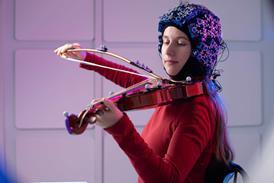
















University of Nottingham researchers used a wearable brain scanner and specially modified metal-free violin to investigate how novice players acquire new musical skills
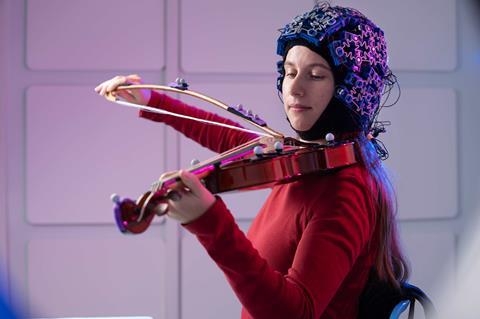
A team led by researchers at the University of Nottingham has used wearable brain-imaging technology to reveal how the brain changes when learning to play the violin, that changes in neural activity linked to motor learning can be detected after just a single lesson.
Published in Imaging Neuroscience, the study tracked 22 novice violinists using an OPM-MEG scanner, a lightweight wearable system developed in Nottingham that allows brain activity to be measured while participants perform natural movements.
Players attempted Twinkle Twinkle Little Star before and after a violin lesson, with researchers analysing changes in ‘beta’ brain waves associated with prediction and movement.
The researchers found that participants showing the greatest changes in beta-wave activity also demonstrated the largest improvements in their playing ability.
Joe Gibson, PhD researcher at the School of Physics and Astronomy, explained: ‘Your brain works by making predictions about what will happen as a result of your actions. So, if I am playing a violin, my brain will have an expectation of what sound it will make. If I play the expected note, my brain receives information that the outcome matched its prediction; if I hit an unexpected note, it receives information that it did not.
‘In this experiment, we were able to measure these signals in real time while the instrument was being played.’
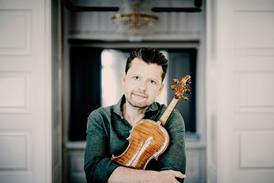
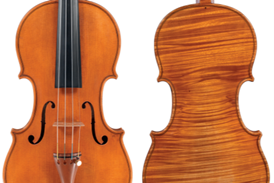
To make the experiment possible, Nottingham violin maker and teacher Alan Kirby modified a violin to remove all metal components, allowing it to be used alongside the highly sensitive scanner, which measures tiny magnetic fields generated by electrical activity in the brain.
‘Bringing together the ancient art of violin making with the quantum physics underpinning this brain scanner has been amazing,’ said Kirby. ‘Perhaps even more impressive was actually to see the effects of my lessons on people’s brains. That was quite an experience.’
According to the researchers, the findings offer new insights into how the brain acquires musical skills and could eventually contribute to a deeper understanding of neurological conditions such as dementia.




















No comments yet