





The influential conductor and champion of historically informed performance practice has died, aged 91
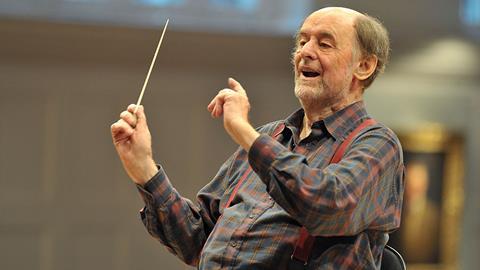
The English conductor Roger Norrington died at his home in Devon, on 18 July 2025, aged 91. Norrington was known for his expertise in historical performance in baroque, Classical and Romantic repertoire.
Norrington was born to a musical and academic family on 16 March 1934. He was a talented boy soprano, studied the violin from age ten and singing from age seventeen. He read English Literature at Cambridge University, and spent several years as an amateur violinist, tenor singer, and conductor, before attending the Royal College of Music as a postgraduate student of conducting, studying with Sir Adrian Boult.
He founded the Schütz Choir in 1962, beginning his 30-year exploration of historical performance practice. The choir recorded and performed mostly 17th-century music, and was initially accompanied by the London Baroque Players, and later the London Classical Players.
Norrington was musical director of the London Classical Players from 1978 to 1997. He directed the ensemble through performances and recordings of Beethoven’s symphonies on period instruments, and later repertoire not only by Haydn, Mozart and Beethoven, but also of many 19th-century composers, including Berlioz, Weber, Schubert, Schumann and Rossini.
His work in historical performance practice advocated the use of little or no vibrato in performances, and strictly followed Beethoven’s original metronome markings in his symphonies. His research into scores, orchestral sound and size, seating and playing style influenced the perception of 18th- and 19th- century orchestral music.
He worked as a guest conductor for symphony orchestras worldwide, working regularly with orchestras in Berlin, Vienna, Leipzig, Salzburg, Amsterdam, Paris, New York, San Francisco, Los Angeles and London. He served as chief conductor of the Camerata Salzburg from 1997 to 2006 and the Stuttgart Radio Symphony Orchestra from 1998 to 2011. He maintained a close association with the Orchestra of the Age of the Enlightenment (OAE), which took over the work of the London Classical Players, and with the Philharmonia.
Norrington was appointed OBE in 1980, CBE in 1990 and was knighted in 1997. He was an honorary fellow of Clare College Cambridge and held honorary degrees from the Universities of York and Kent and an honorary doctorate from the Royal College of Music, where he served as Prince Consort professor of historical performance.
He announced his retirement in 2021, delivering his final concert that year at Sage Gateshead with the Royal Northern Sinfonia playing music by Haydn.
The OAE shared a video tribute to Norrington on social media: ’A tremendous presence in the musical world may be gone but his legacy was transformative and will endure through the music-making of the OAE and the many other ensembles he was such a part of.
’We were privileged that recently he so generously spent time filming his thoughts on Beethoven for us. There was perhaps no other composer for whom Sir Roger changed so completely what we thought we knew about his music.’
Read: ‘Keep it simple, stupid’ - recording Mozart Violin Concertos the historically informed way
The number one source for playing and teaching books, guides, CDs, calendars and back issues of the magazine.
In The Best of Technique you’ll discover the top playing tips of the world’s leading string players and teachers. It’s packed full of exercises for students, plus examples from the standard repertoire to show you how to integrate the technique into your playing.
In the second volume of The Strad’s Masterclass series, soloists including James Ehnes, Jennifer Koh, Philippe Graffin, Daniel Hope and Arabella Steinbacher give their thoughts on some of the greatest works in the string repertoire. Each has annotated the sheet music with their own bowings, fingerings and comments.
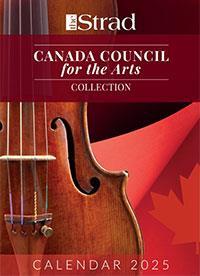
The Canada Council of the Arts’ Musical Instrument Bank is 40 years old in 2025. This year’s calendar celebrates some its treasures, including four instruments by Antonio Stradivari and priceless works by Montagnana, Gagliano, Pressenda and David Tecchler.









No comments yet