




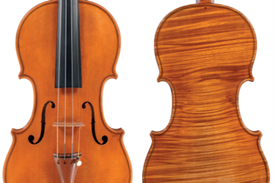
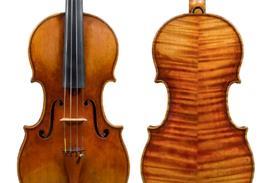

The 1894 Anton Zunterer violin, which Einstein likely played while developing his theories of relativity, will be auctioned on 8 October
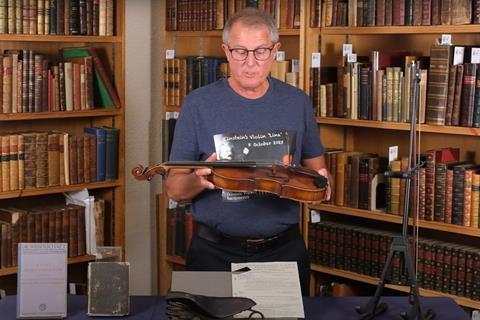
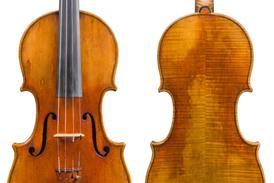
Dominic Winter Auctioneers in Cirencester, UK, has announced it will be auctioning an 1894 violin made by Munich-based maker Anton Zunterer on 8 October, one which formerly belonged to German theoretical physicist Albert Einstein. It has been estimated at £200,000.
It is believed to be the first violin Einstein ever bought, possibly before he went to study and work Switzerland in 1895 at the age of 16, where there are accounts of him playing violin regularly.
This would make it the instrument he played while developing his theory of special relativity and general theory of relativity. The next time Einstein would purchase a violin would be in 1919, and it is believed that that is the instrument he took with him to the US.
In 1932, Einstein was visited at his summerhouse in Caputh, Germany, by friend and colleague Max von Laue. There, Einstein informed Laue that intended to leave for the US, possibly never to return.
He gifted the violin to Laue, suggesting that perhaps his son may like to learn to play it, as well as a philosophy book of René Descartes and Baruch Spinoza published in 1843, which Einstein said his father had given him to encourage him to learn Latin, a bicycle, and the order form for the bicycle saddle from 1929. The book, the form and the bicycle saddle will join the violin on auction.
Laue kept the items for many years, until in 1952 he gifted it to his acquaintance Margarete Hommrich, an avid fan of Einstein. They have remained within her family ever since, handed down through the matrilineal line, and it is Hommrich’s great-great-granddaughter that has put the items up for auction.
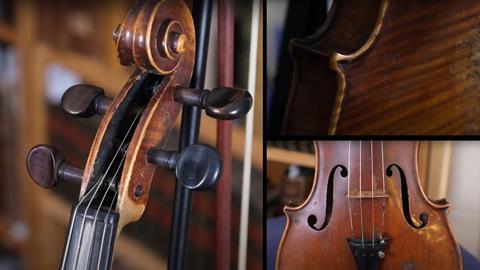
Einstein is known to have nicknamed his violins Lina – short for ‘Violina’ – and in this case, Einstein has etched the name onto the back of the violin. The fine tuners and tail loop have been modernised, but the rest of the instrument and the chin rest are purported to be the original. When it was brought in for assessment, the bridge had collapsed and the soundpost was loose, and it had reportedly not been played for many decades.
Once in America, Einstein was gifted an 1933 violin made for him by cellist and cabinet-maker Oscar Steger: this was auctioned in the US for $516,500 in 2018, triple its estimate.
Chirs Albury, an auctioneer and senior valuer at Dominic Winter Auctioneers, makes the case for why this violin may be worth even more:
‘In my opinion, this is much more important… [Einstein’s] great years as a scientist are 1905 and 1912, his papers on special relativity and general relativity. Even if we don’t understand them, we all know E= MC2.
‘So all that time, from the 1890s up until he bought his violin in 1919, this was likely his instrument. He would have been playing this while thinking about physics, and physics and music go together so well.
‘It’s just incredible to think that this very instrument might have been triggering some of his great ideas while he was playing Mozart or Bach.’
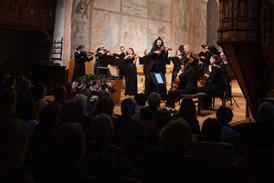
Watch violinist Theo May perform Bach’s Violin Partita no. 2 in D minor on the violin here:










No comments yet