





![Ayanna Witter-Johnson [Jordan Woods] 7](https://dnan0fzjxntrj.cloudfront.net/Pictures/274x183/4/9/4/44494_ayannawitterjohnsonjordanwoods7_224583.jpg)






All Lutherie articles – Page 4
-
 Premium ❘ Feature
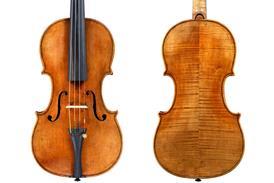
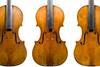
‘Interventions led to an almost total removal or retouching of the original materials’ - Comparing three 1734 Guarneris
Giacomo Fiocco explains the technical methods used to analyse a trio of 1734 Guarneris
-
 Premium ❘ Feature
François-Nicolas Voirin: The Second Tourte
The bows of François-Nicolas Voirin had more influence than those of any other bow maker after F.X. Tourte. In the first of two articles, Matt Wehling explores Voirin’s life and career, and examines why his bows were so successful with players
-
 Premium ❘ Feature
G.B Guadagnini’s 1773 ‘Cozio’ viola: The only constant is change
The commercial relationship between G.B. Guadagnini and Count Cozio di Salabue allowed the luthier greater freedom to experiment. Alberto Giordano and Barthelemy Garnier examine a 1773 viola to show how the 62-year-old maker continued to adopt new methods and ways of working in this period
-
 Premium ❘ Feature
Violin making in Seoul: Gangnam style
Over the past decade, a wide community of violin and bow makers has grown up in the Seocho district of Seoul. Luthier Hagit Gili Gluska speaks to colleagues young and old, both local and from overseas, who have made this area their home
-
 Premium ❘ Feature
Schroetter and Roth: Two of a kind
With the demand for mass-produced German instruments skyrocketing in the 1920s, enterprising makers sent family members to America to represent them. Clifford Hall explores the careers and legacies of Andrew Schroetter and Heinrich Roth
-
 Premium ❘ Feature
Early lutherie experience: The journeyman years
The time spent between finishing at violin making school and striking out on your own can be critical to a luthier’s learning experience. Peter Somerford finds out what makers should expect from their first jobs in a workshop – and how they can make the most of their time
-
 Focus
FocusVuillaume’s ‘Alard’ bows: Small but beautiful
In the extensive literature concerning Jean-Baptiste Vuillaume, there is very little about one of his more remarkable innovations: a refinement of the bow frog design that can be seen on many examples from his workshop. Michel Samson explains how the so-called ‘Alard’ bow was designed to make life easier for ...
-
 Premium ❘ Feature
Wood treatment: The magic touch
New research has revealed how Stradivari, Amati and Guarneri ‘del Gesù’ all used tonewood that had been heavily treated with chemicals prior to carving. Wenjie Cai and Hwan-Ching Tai explain the study’s findings, and suggest it could indicate that the Cremonese makers were influenced by the contemporary alchemical beliefs
-
 Premium ❘ Feature
Bay Area bow makers: Bows on the bay
With a large and growing music community, the San Francisco Bay Area became a hotbed of violin and bow making talent in the early 20th century. Raphael Gold tells the stories of the most prominent bow makers of the day
-
 Premium ❘ Feature
Historical varnishes: Beneath the surface
The inclusion of minerals in Italian varnishes from the 16th to mid-18th centuries has long been a source of speculation. Balthazar Soulier, Stefan Zumbühl and Christophe Zindel present the first results of a long-term study showing that key answers can be found in early German recipes
-
 Premium ❘ Feature
Violin making and AI: Intelligent design
The science of violin acoustics has encompassed 3D scanning, CNC technology and good old-fashioned tap tones – so why not AI software? Sebastian Gonzalez presents the results of a project that could help predict an instrument’s tone qualities even before it’s made
-
 Premium ❘ Feature
Herrmann bow making dynasty: An enduring legacy
Like their close contemporaries the Knopfs, the Herrmann family of bow makers left behind a large number of bows, many of which show exquisite craftsmanship. In the second of two articles, Gennady Filimonov examines their history, their connections with the Knopfs, and several examples of their work
-
 Premium ❘ Feature
Violin making schools in China: The way of the future
In the second of two articles on violin making in China, Sisi Ye examines the schools teaching the art of lutherie to young people, where tuition can last up to ten years and a grounding in music theory is essential
-
 Premium ❘ Feature
Knopf dynasty: A tangled web
Three bow makers of the Knopf family are well known: Christian Wilhelm, Heinrich and Henry. But the dynasty comprises more than a dozen members, many of whom deserve recognition. Gennady Filimonov draws on archive material supplied by the Knopf descendants
-
 Premium ❘ Feature
Tracing the truth: Stradivari’s early cellos
What cello moulds were used in the Stradivari workshop? The question has long gone unanswered, despite the number of artefacts – and even intact moulds – that survive. Philip Ihle examines 17 of the cellos made before 1700 to find out how many moulds may have been used before the ...
-
 Premium ❘ Feature
Song of the gut string makers
In 1877, Markneukirchen in Germany was at the heart of the world’s string making industry. The townsfolk were so proud, they even composed a drinking song all about it. Kai Köpp explains what the lyrics (translated into English for the first time) reveal about this convoluted process
-
 Premium ❘ Feature
Ludwig Bausch: Gone… but not forgotten
Respected during his lifetime, Ludwig Bausch was almost unknown just a few years after his death – and his bows were considered unremarkable junk. Josef P. Gabriel reveals why the maker and his family were almost lost to history, and why his work deserves to be listed among the greats
-
 Premium ❘ Feature
Lutherie in China: the enterprise system
China has become a world leader in stringed instrument making, based on a system of bulk production combined with respect for craftsmanship. Sisi Ye speaks to the heads of manufacturing firms in Pinggu, Queshan and Huangqiao to learn more
-
 Premium ❘ Feature
Behind the Curve: the evolution of the bow
The evolution of the bow is inextricably tied up with the needs of the player, and the changing face of society. Paolo Sarri examines the development of the ‘ancient’ and ‘modern’ curves of the bow stick, dispelling a number of myths along the way
-
 Premium ❘ Feature
The viola d’amore: For a sympathetic ear
The viola d’amore is undergoing a resurgence in popularity among early music groups, with a wealth of repertoire still to be rediscovered. Rachael Durkin tracks the development of this unique instrument, examining its many precursors along the way