














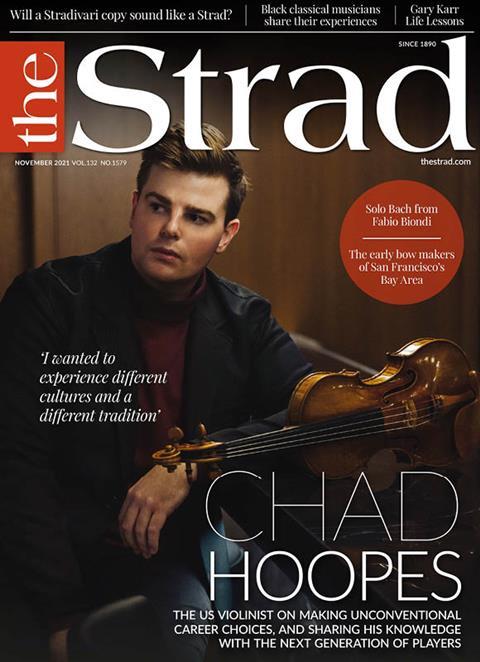
Béla Bartók’s 1944 Sonata for solo violin is a key piece of repertoire for the American violinist, who discovered its ‘ability to reach out and grab people’ while in the New York subway

Discover more Featured Stories like this in The Strad Playing Hub.
Read more premium content for subscribers here
Bartók’s Sonata for solo violin is a work that changed me from the inside out – in learning it, studying it, performing it, and now in teaching it. My students often choose to study it, and it’s an excellent piece for them: on the face of it, it seems very mathematically centred and ultra-intellectual, but when you get deeper into the structure, it ends up being quite emotional.
I first heard the sonata in my late childhood. We had a huge CD collection and I worked my way through it. I already knew a few pieces by Bartók but this was one of a handful that made me realise that I really loved his work. I even had a go at practising it a little, although there was no way I was capable at that time!
I only really started studying it as an adult, and I remember my teacher saying that the key was if I just tried to ‘learn how to play it’, I’d never be successful with it. I had to understand what Bartók was trying to say, or the piece itself would reject me.
What I think that means is that because it’s so difficult, there’s a temptation to treat it as a technical showpiece. But if you end up trying to make it about yourself, it stops making any kind of sense. As I’ve got older and more familiar with it, I’ve found that performing the sonata is an act of self-understanding, rather than self-importance.
Similarly, I’ve heard many recordings of the sonata, but after each one, I realise that the piece speaks louder than the input from any performer. And there are very few pieces like that.
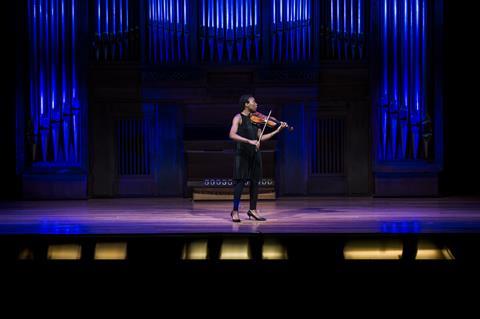
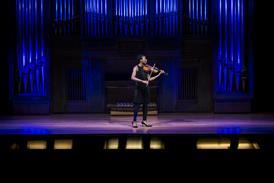
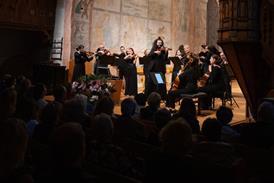
I didn’t perform the sonata in concert until 2009, when I played it at the BBC Proms as a New Generation Artist. That summer, I practised it in all kinds of places to gain experience: playing it for my friends and even in the New York subway. That was where I realised its ability to reach out and grab people – even though it was an audience of commuters running to catch their trains, they would stop and listen – which hardly ever happens. I’m sure it was because the piece is so intrinsically arresting, rather than because they were somehow impressed by me!
When I first started practising the sonata, I just enjoyed it; later, I felt that I’d found some understanding of it too. I think that the key is to search for patterns and look for the structural meaning of the phrasing. It’s very easy to get stuck on the fine details, worrying about individual notes, and if you find yourself doing that, then you’re missing the point.
Instead, you should be asking: why did he write that dynamic? Is it just to be soft, or does Bartók want it to convey some kind of emotional impact? Is it loud because he’s trying to keep the tempo, or is it because he’s expecting the tempo to be corrupted? In other words, the questions you ask should be interpretative, not simply based on ‘can I do this?’
It’s also important to understand what Bartók was doing at the time, the other pieces he was working on and so on. He created a unique musical language for himself, and uses similar patterns of markings throughout his writing, which takes time to understand properly. It’s fascinating to me that he worked in such an uncompromising way.
INTERVIEW BY CHRISTIAN LLOYD














No comments yet