









Carlos María Solare reports from the wide-ranging and eventful second edition of the Hindemith International Viola Competition
Discover more Featured Stories like this in The Strad Playing Hub.
Read more premium content for subscribers here
Back for its second iteration, the Hindemith International Viola Competition (HIVC) took place from 8 to 15 October 2025 at the history-charged main building of the Hochschule für Musik und Theater, which had been built in 1930 as the Nazi Party’s Munich headquarters. Having attended the event four years ago (see The Strad, January 2022), I was pleased to take in an exhibition honouring both its eponymous composer and Walter Witte (1928–2020), the founder of the competition in its original guise in 1996. By profession a lawyer, Witte was a gifted artist and a passionate amateur violist. The exhibition, titled ‘For the Love of the Viola’, showed a selection of his drawings and offered much information about Hindemith’s concert career as a viola soloist. It provided a fascinating insight into both men, and perhaps went some way to exorcising the infamous legacy of the space it occupied.
HIVC artistic director Roland Glassl, viola professor at the university, recruited an international jury headed by Hartmut Rohde (Berlin University of the Arts) and featuring Veronika Hagen, Hsin‑Yun Huang, Garth Knox, Paul Pesthy, Geneviève Strosser and flautist Henrik Wiese, with music education specialist Sonja Stibi joining them for the semi-final round. The bill of fare for the quarter-finals consisted of contrasting movements from unaccompanied works by Bach and Hindemith, and a specially commissioned work by German composer Isabel Mundry. The new piece (Komposition für Viola) is a demanding exercise in sophisticated microtonal playing, during which the violist is additionally required to wander through constantly varying contact points between extreme sul ponticello and sul tasto. It was fascinating to see how the 16 quarter-finalists coped with this extremely – and, arguably, unnecessarily – complicated work. Some seemed to concentrate either on the microtones or the changing contact points to the detriment of the other elements, but each was able to weld the three contrasting movements into a convincing whole.
Most Bach renditions were beautifully stylistic, whether the player used a Baroque bow – as three competitors, all from China, did – or a modern one. Xunyu Zhou (17) started with a lovely, buoyant Prelude and a finely attuned Sarabande from Bach’s C major Cello Suite, going on to a beautifully phrased ‘Sehr langsam’ from Hindemith’s Solo Viola Sonata op.25 no.1 in which she avoided dividing the original, long slurs, and a distinctly articulated ‘Rasendes Zeitmass. Wild’ which actually featured the ‘beauty of tone’ that Hindemith proclaimed to be ‘of secondary importance’.
The second-youngest competitor, 19-year-old Finn Martta Kunnola, essayed Hindemith’s little-played op.31 no.4 with phenomenal bravura in the toccata-like opening movement and intimate shades in the following ‘Lied – Ruhig, mit wenig Ausdruck’. Her E flat major Bach Cello Suite was a tad overembellished in the Sarabande but genuinely dancing in the stomping Bourrées. Miranda Werner (25) performed the same Bach suite with an elegant gait in the Sarabande and a nicely improvisatory feeling in the Prelude. Her Hindemith – the seldom encountered ‘1937’ Sonata – featured some beautifully gauged pizzicato chordal playing and impeccably tuned 4ths.
The eight semi-finalists were required to curate a programme around Hindemith’s Viola Sonata op.25 no.4, and to introduce it in their own words. Their choices of repertoire were as varied as their ways of expressing themselves verbally. The only competitor speaking in her native language, the American Werner, eloquently presented a programme of music by violist–composers that included a lovely arrangement of Dvořák’s Silent Woods and Rebecca Clarke’s Morpheus, finishing with an exuberant Phantasy by York Bowen.
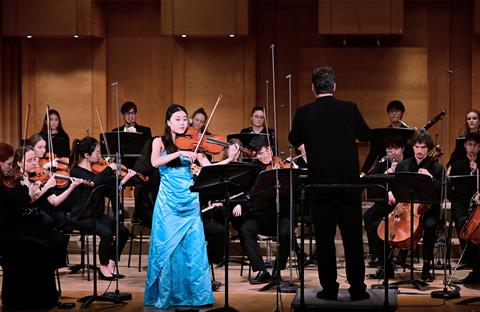
Zhou provided a history lesson, tracing Hindemith’s lineage to Bach (Viola da gamba Sonata in G minor BWV1029) via Mendelssohn (Felix and Arnold) and Hindemith’s composition teacher Bernhard Sekles, whose Chaconne for viola and piano op.38 proved a real repertoire find.
Chinese Yanan Wang (25) also linked Hindemith to Bach (Viola da gamba Sonata in D major BWV1028), throwing in Clarke’s Morpheus and the Second Viola Sonata by Hindemith’s viola-playing friend Milhaud, a piece whose dramatic vein suited her.
The Japanese 23-year-old Ayaka Taniguchi’s lecture emphasised Hindemith’s position between tradition and modernity, reminding us that he had premiered several pieces by the short-lived Erwin Schulhoff, whose 1930 Hot Sonata (originally for saxophone) was the centrepiece of her recital. She performed it with convincing swing, the slightly nasal quality of her viola proving advantageous.
Her pianist occasionally covered her in their well-paced Hindemith op.25 no.4, but she was heard unaccompanied in beautifully intimate renditions of Bach, Reger, Stravinsky and Hindemith (op.31 no.4): four slow movements in a row, but each given its own sound world and a personal touch. Zhou and Werner didn’t go on to the finals, but the latter received the special Walter Witte Prize for the best interpretation of the commissioned piece.
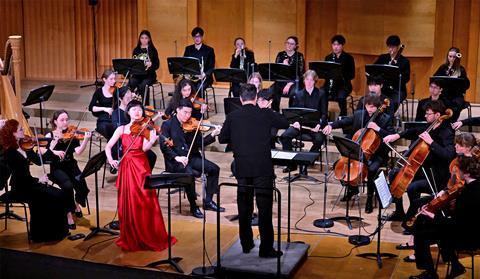
The last round featured Debussy’s Sonata for flute, harp and viola – with Anne-Cathérine Heinzmann and Andreas Mildner – and Milhaud’s Viola Concerto no.1 accompanied by the university orchestra under Giuseppe Montesano. Unfortunately, it soon became clear that Kunnola wasn’t on her best form, in spite of a beautifully sung Lent movement in the Milhaud. Playing with considerable aplomb, Wang was short on the concerto’s cheeky humour, and her sound lacked sensuousness in the Debussy.
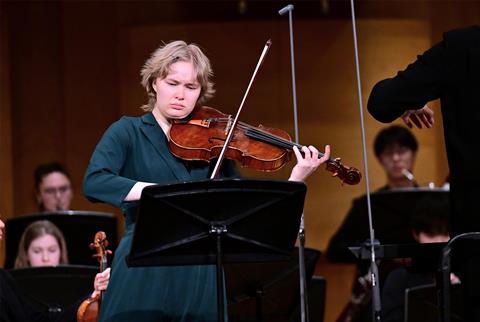
It was left to Taniguchi to deliver the winning performances: maintaining watchful eye contact with her colleagues at key moments, she consistently found sensuous nuances in Debussy and avoided being covered in Milhaud’s over-orchestrated concerto. With lively syncopations, witty glissandos, fiery cadenzas and beautifully cultivated sound throughout, her rendition secured her the first prize (€8,000) as well as the Audience Award; she also received the special Fondation Hindemith Prize for the best interpretation of op.25 no.4. Wang took home the second prize (€4,000) and the special prize for the best semi-final lecture, while Kunnola received the third prize (€2,000).
Interspersed with the competition rounds, masterclasses given by jury members were offered to violists studying at the university as well as to competition participants no longer in the running. These provided useful insights into their approach to various issues. Rohde highlighted the rhetorical elements in Bach’s music, while Huang concentrated on the nuts and bolts of sound production.
Of the non-competitive performances, jury member Huang’s tour de force of unaccompanied music by György Ligeti, Atar Arad, Sally Beamish, Kenji Bunch and others can’t be left unmentioned. Emiko Yuasa, winner of the 2021 HIVC, contributed lovely Schumann and Vaughan Williams. Ionel Ungureanu, a most interesting player from the 2021 competition, performed with his fusion band Borsch4Breakfast some exciting arrangements of the folk songs referenced in Hindemith’s Der Schwanendreher.
With its focus on the viola’s most celebrated composer, after its second iteration the HIVC is indeed well established in the international competition landscape.
Read: Letters from America: 130 years of Hindemith
Read: Postcard from Gateshead: Tertis and Aronowitz International Viola Competitions
Discover more Featured Stories like this in The Strad Playing Hub.
Read more premium content for subscribers here









No comments yet