




Harriet Smith reports from the Aldeburgh Festival, where string works were much in evidence

The allure of Aldeburgh proved as powerful as ever in the year marking the 50th anniversary of Britten’s death – even during the growing heatwave that engulfed much of the UK in June. There was, as usual, so much string-related gorgeousness that it was tricky to reduce my long list to just a few concerts.
My festival experience began with a morning with Nicolas Altstaedt & Friends (16 June), a concert of Tom Coult, Birtwistle, Britten and Shostakovich. Altstaedt (one of the festival’s featured artists) began alone, with the UK premiere of Coult’s inventively titled Craftsmen and Clowns and proved utterly inside the characterful three short movements.
Still greater brevity came with Harrison Birtwistle’s Nine Settings of Lorine Niedecker, for which he was joined by the silvery soprano of Anna-Lena Elbert. The performers dazzled in the sheer imagination of Birtwistle’s textures, and you never felt the lack of a grounding keyboard instrument. That arrived in Britten’s Cello Sonata with Ryan Wigglesworth, busy as a featured artist as conductor, composer and pianist. He and Altstaedt gave a reading that was always fresh-sounding, unafraid to bring out the work’s innovation.
Unfortunately, I still had in my mind the performance from a couple of years back by Alban Gerhardt and Steven Osborne and this felt a little safe by comparison. Rounding off the programme was Shostakovich’s Blok Romances, with the three performers now joined by violinist Benjamin Marquise Gilmore: they clearly relished the composer’s inventive use of different sound worlds for each piece.

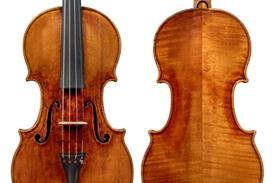
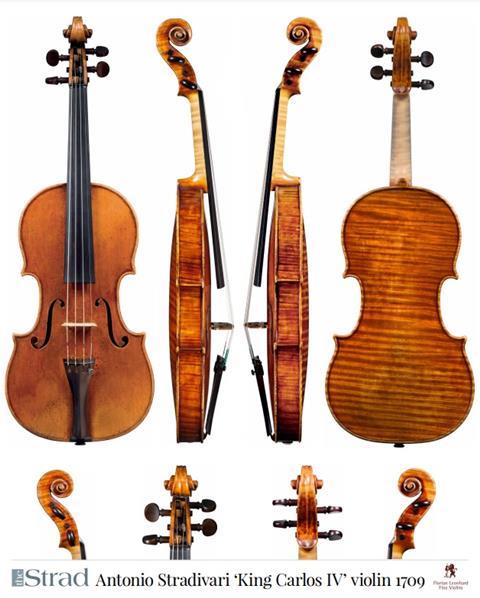
Expectations were particularly high for the evening’s performance – Isabelle Faust and Kristian Bezuidenhout playing all six of Bach’s Sonatas for violin and harpsichord. I treasure their recording of the pieces released eight years ago and their interpretation continues to evolve with every performance. The duo cut a handsome pair, Bezuidenhout at a beautiful two-manual harpsichord, Faust with her ‘Sleeping Beauty’ Strad, in a wonderful outfit of champagne silk.
All the characteristics of Faust’s approach to Baroque music were on display – the poise, the easy virtuosity, vibrato used only as an effect. The sense that this is a conversation with her partner was uppermost, time and again Bezuidenhout offering flourishes to which Faust would then respond and vice versa.
Effective too was the switching to a single manual for movements such as the third of the Second Sonata, against which Faust presented legato lines. Joy and a sense of dance underpinned many of the finales, but always with time to breathe amid the hustle and bustle. The audience knew this was special and remained absolutely silent until the fifth movement of the final sonata had ended. After which the place erupted!
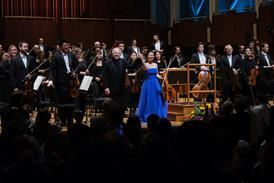
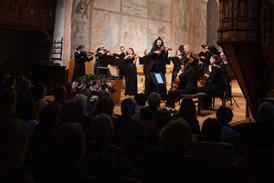
To the bigger forces of Britten Sinfonia conducted by Gemma New for the following evening (17 June). In fine Aldeburgh tradition, the programme was eclectic but never gimmicky; it began with Steve Stelios Adam’s Et døgn (‘A day in a life’) with a single player, Genevieve Lacey, with a family of recorders plus computer-generated sounds that conjured a forest filled with bird calls.
From here via Lisa Illean’s arrangements of Binchois Chansons – the string players of Britten Sinfonia stately and serene – to the UK premiere of Illean’s Swellsong, which though expertly played seemed overextended. Brett Dean’s Carlo for strings, sampler and pre-recorded voices on the other hand, was a winner. In it, Dean offers a meditation on Gesualdo’s genius and his lurid life story to powerfully moving effect. The way he intersperses pre-recorded voices singing Gesualdo with the string writing reminds us that he’s a master of the theatre. And the close was stunningly shocking.

Laura van der Heijden was soloist in Britten’s Cello Symphony. Speaking after the performance before her encore of Scarborough Fair, she admitted: ‘I can’t begin to tell you what a thing it has been to play this piece here.’ Her conviction was evident from the off, and she and the conductor were always alive to the inventiveness of Britten’s textures. Throughout, van der Heijden was very much first among equals in the mix and her sense of making the piece her own was truly impressive.

Returning to the festival on 21 June, I drove through the misty midsummer light – somehow apt for Schubert’s C major Quintet. In the best Aldeburgh tradition, here was an intergenerational line-up that made for the best kind of chamber music-making. Brothers Magnus and Guy Johnston as first violin and first cello, rising star Irène Duval as violin 2, Brett Dean as violist and Laura van der Heijden as second cello.
Sitting just four rows from the stage I could sense how closely they were listening to one another; the pacing of every movement was just so and the sense of moulding the narrative worked beautifully. The faster minor-key section in the midst of the slow movement, for instance, had a true disquiet to it, while the scherzo was full of play in its pursuit – making the trio, with its sustained inwardness, all the more shocking. In the finale all five were alive to the character of the contrasting episodes, and in the coda they upped the tempo thrillingly. The audience, silent throughout, let rip in its enthusiasm.
HARRIET SMITH







No comments yet