











Tully Potter reads Julian Lloyd Webber’s tome collecting together the wit and wisdom of the iconic 20th-century cellist Pablo Casals
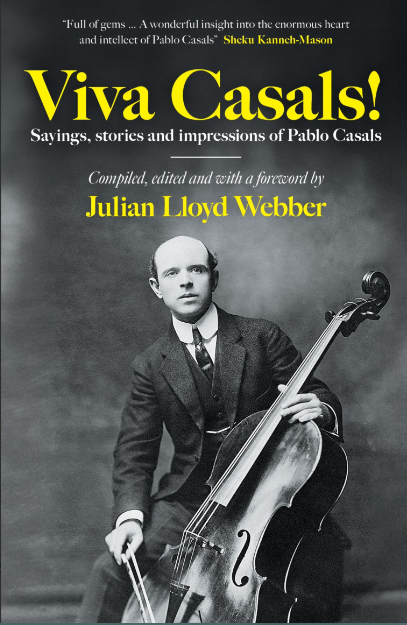
Viva Casals! Sayings, stories and impressions of Pablo Casals
Julian Lloyd Webber
192PP ISBN 9781785909887
BITEBACK PUBLISHING £9.99
This is a friendly little book that will go on to my shelf of tomes about Casals, already fairly crowded. Julian Lloyd Webber has provided a Foreword in which he says: ‘There is no cellist today who has not, in some way, been touched by Casals.’ I am sure he is right.
The text is in 37 sections, often very short. Four pages are devoted to Casals’ mother, with whom he clearly got on much better than with his father. She always had faith in him. Inevitably there is a section on Bach and one of the most interesting sequences is about Casals as a conductor. There is a good Toscanini tale and Adrian Boult features on several pages.
I was glad to be reminded that when the Spanish Civil War broke out, Casals was preparing the Beethoven Ninth with his own orchestra in Barcelona. I missed two stories about his intransigence, one about refusing to play because the conductor did not believe in the Dvořák Concerto, and one about his keeping an audience waiting for 45 minutes because he was insisting on being paid in advance by a dodgy impresario.
It is fun to have Stravinsky’s rejoinder – new to me – to what Casals and Kodály said about him, Kodály comparing him to a tailor always keeping up with the latest fashion; but it would have been nice to have the pair’s original dialogue, which was hilarious. It is preserved on film somewhere.
I also cannot think what JLW was doing, in attributing to Casals on page 157 one of the oldest and corniest wisecracks in the after-dinner joke book. It was surely current a couple of centuries at least before Casals was even born. And the Haydn Concerto recording mentioned on pages 133-4 was left unfinished when Casals abruptly ended his career for political reasons.
These minor strictures aside, a lot of pleasure can be had from this album of memories of a great musician and natural philosopher. He did not like modern music, that is for certain, but he did an enormous amount for the music that he did like. He often came out with eminently quotable quotes, such as: ‘The most perfect technique is that which is not noticed at all.’ Or: ‘The art of interpretation is not to play what is written.’ A four-page section printed on art paper reproduces ten well-chosen illustrations.
TULLY POTTER
Watch: Pablo Casals performs The Song of the Birds









No comments yet