







Stefan Hersh reads Jan Strick’s long-awaited survey of instrument makers from Flanders, including contributions by Anne-Emmanuelle Ceulemans and Guy Rooryck
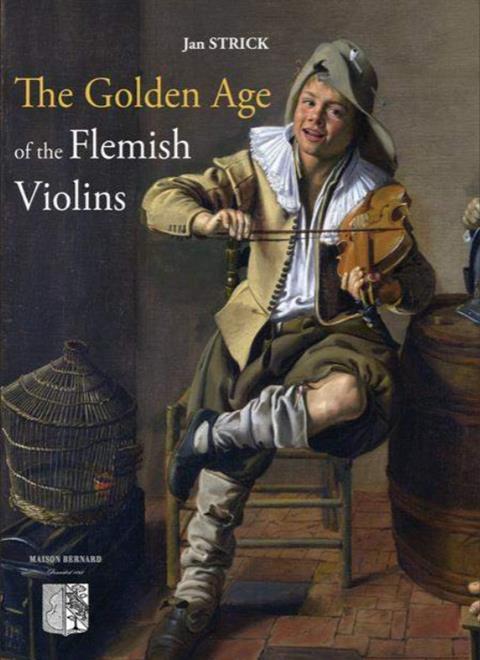
The Golden Age of the Flemish Violins
Jan Strick
348PP ISBN 9789090406930
MAISON BERNARD €240
Flanders has a long and colourful history as a centre of commerce and culture. In the first half of the 16th century, under the reign of Charles V of Ghent, Antwerp was the wealthiest city in Europe. Affluent local patrons supported painters such as Van Eyck and Rubens as well as producers of luxury goods, such as fine stringed instruments. By the mid-17th century, ateliers in Brussels, Ghent and Antwerp were building upscale violins for both local and export clientele. But by 1740, the golden age of violin making in Flanders had faded. French violin making methods overtook the old ways, and the Flemish violin making tradition was all but forgotten.
Despite the beauty of old Flemish instruments, lutherie in the region has remained an obscure topic even within the trade. Max Möller’s 1955 book The Violin-Makers of the Low Countries was the first attempt to document lutherie in Flanders and remained the only publication covering the subject for 70 years. A fresh look at Flemish violins has been long overdue.
Jan Strick’s new book The Golden Age of the Flemish Violins answers the call with breathtaking comprehensiveness. This revelatory volume is organised into two sections. Part 1 includes an introduction by Strick, describing his origins in the trade and his lifelong quest for Flemish violins, as well as a fascinating historical overview of Flanders by Anne-Emmanuelle Ceulemans, curator of the instrument collection at the Musical Instrument Museum (MIM) in Brussels. These are followed by Guy Rooryck’s short biography of instrument collector César Snoeck (1834–98), the residue of whose once-vast collection still resides in the MIM.
Then come a few pages describing the rise and fall of violin making in Flanders from the 16th to the 18th centuries, and a short but highly informative section on the techniques of the Flemish school, by Strick. After that are two pages detailing inconclusive attempts to date Flemish instruments dendrochronologically.
Read: Violin making firm Maison Bernard wins €100,000 PFV Prize
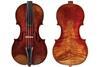
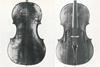
Part 2, detailing the makers themselves, is sensibly organised by the cities of Antwerp, Brussels and Ghent, with a final section devoted to Mons, Tournai and Lille. Short biographies of known makers in each city are followed by high-quality photos of numerous examples. Most in the trade have known the names of a few Flemish violin makers to whom a handful of instruments have been ascribed. Strick’s volume marks a monumental leap forward, beginning with the family tree of the dominant Hofmans instrument-building dynasty, and moving on to the Borlon, Borbon, Roettenburgh, Snoeck, Boussu, DeLannoy and Willems dynasties, alongside noted individual makers such as Ambroise De Comble. The superior quality of the instruments, with their Flemish stylistic traits, is revealed in stunning detail. The volume inspires a high regard for the sophistication of early Flemish violin making, spanning several generations.
New publications in the field of antique violins and bows rarely possess the transformative potential of The Golden Age of the Flemish Violins. This publication will advance the collective understanding and appreciation of Flemish stringed instruments and will help experts identify the large number of beautiful old Flemish violins that have been misattributed to Italian makers over the years. It is destined to become an essential volume in any library devoted to the study of antique stringed instruments.
STEFAN HERSH









No comments yet