






From its residency with San Francisco Performances to a New York debut and a tenth anniversary concert in Seoul, the Esmé Quartet reflects on a year that blends Schubert, Mendelssohn and a world-premiere by Juri Seo
Read more Featured Stories like this in The Strad Playing Hub
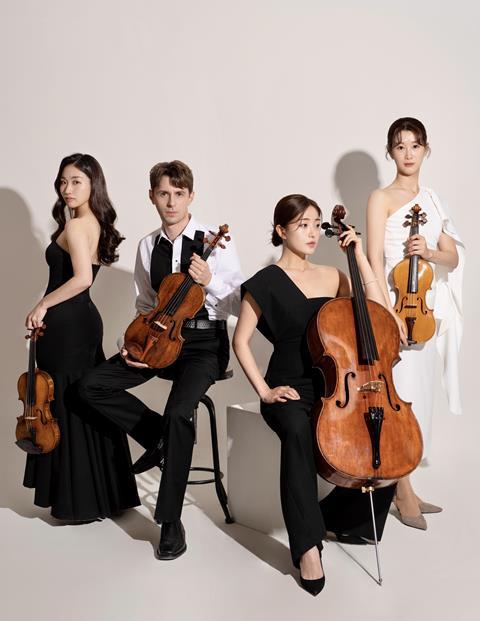
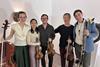
The Esmé Quartet is in the middle of a busy season. The quartet, which formed in Cologne, Germany, in 2016, is now based in San Francisco, and has recently wrapped up its residency with San Francisco (SF) Performances. Its members – violinists Wonhee Bae and Yuna Ha, violist Dimitri Murrath and cellist Yeeun Heo – serve as visiting artists and faculty at the San Francisco Conservatory of Music.
The season also features the quartet’s highly anticipated New York debut at The Frick Collection in March, continued tours across North America and Europe, and will culminate in a special 10th anniversary celebration concert at the Seoul Arts Center in June 2026.
In between, the ensemble is finding time to record a world-premiere commissioned work by Korean-American composer Juri Seo, as well as Fanny Mendelssohn’s String Quartet in E-flat major.
The quartet, which won the 2018 Wigmore Hall International String Quartet Competition and numerous prizes at other competitions, caught up with The Strad to talk about its season highlights.
How has your time with SF Performances shaped your artistic growth and ensemble dynamic?
Our first large-scale residency was actually at the Lotte Concert Hall in Seoul during the pandemic in 2020–2021. At that time, we curated programmes around the idea of exploring our ’all-time favourite’ works by major quartet composers – we joked that anyone who came to all the concerts would become a ’quartet master.’.
Our residency with SF Performances has allowed us to take this concept much deeper and in a more focused direction. This season, our theme is Late Schubert, and performing these works within just a few months – alongside Robert Greenberg’s illuminating lectures – has helped us differentiate each piece more clearly in terms of style, history, and emotional character. It has been an invaluable experience, and we already look forward to discovering our next theme for the upcoming season.
The audience at SF Performances has been incredibly warm, and having this concert series as our ‘home base’ means a lot to us. Each year, the Saturday morning series with Robert Greenberg centers around a different theme. For our first year, we chose Schubert: the Quartettsatz, the last three quartets, and of course the Cello Quintet. Except for ’Rosamunde’, these are all works that have been in our repertoire for some time. We can’t reveal our next theme yet, but we’re excited to share it soon. Programmes like these encourage us to explore repertoire with much greater depth and intention.
What drew you to Juri Seo’s commissioned work, and how does it complement Fanny Mendelssohn’s String Quartet in E-flat major?
We began performing Juri Seo’s music about a year ago. Since the early days of our quartet, we have made a point of including works by Asian women composers, and as we listened widely, her music stood out for its distinctive voice. Much of her writing is inspired by nature, which is also true of this new piece, River at the end of the mind.
For our new album, we wanted to center the theme of sibling love – the bond between Felix and Fanny Mendelssohn. Connecting this to our Korean background, we chose to include a traditional Korean song, ’Ummaya, Nunaya’, which speaks about the love between siblings and mothers. Juri created a theme and six variations based on this song.
Her piece offers a beautiful emotional counterpart to Mendelssohn’s op. 80. While op. 80 is filled with despair after Fanny’s passing, Juri describes her work as expressing not only the ’yearning darkness of the original song,’ but also a sense of ’transcendence – toward peace’. Combined with the exuberance of Fanny Mendelssohn’s quartet, River at the end of the mind helps balance the album emotionally and brings all the works together into a cohesive narrative.
Juri Seo’s new piece is a world premiere. What unique qualities or challenges does this work present, and how are you approaching its interpretation?
It has been a fascinating process. The biggest difference with a world premiere is that we can engage directly with the composer throughout. When we first contacted Juri, we asked specifically for the Korean song to be woven into the piece. Before the premiere, we’ll also have several rehearsals with her, during which she may refine certain details. She will give us feedback on how to bring out the intentions behind her writing.
This is, of course, very different from working with Mendelssohn, where we cannot simply call the composer! With historical works, our approach must be more intuitive – grounded in score study, historical context, and our own imagination. With a living composer, we gain invaluable insight straight from the source, and that shapes our interpretation in a very meaningful way.
With a living composer, we gain invaluable insight straight from the source, and that shapes our interpretation in a very meaningful way
How do you approach balancing historical repertoire with contemporary works in the same recording?
We believe it’s important to present both old and new works side by side, especially as a way of introducing audiences to contemporary music. There is so much extraordinary music being written today – it deserves to be heard and is deeply relevant to our time.
At the same time, we cherish the traditional quartet repertoire and continue to explore it with great dedication. What matters most to us is the message we hope to convey. For this album, the theme of sibling love felt universal and deeply human. Music allows us to express that theme in many different ways, and presenting it through both historical and contemporary voices felt natural and meaningful to us.
What does your upcoming New York City debut at the Frick Museum debut mean for you, and how are you preparing for it?
New York City holds enormous cultural significance both in the US and internationally, so making our debut here feels particularly meaningful – especially in our ten-year anniversary! – and also now that the US is our home. We have heard how stunning the new Stephen A. Schwarzman Auditorium is, not only architecturally, but acoustically.
We’ve planned a series of performances leading up to this concert so that the Frick becomes the culmination of our touring period. Performing in a museum environment also resonates with us – it allows the programme to be experienced not only as music, but as part of a broader artistic and cultural context.
How do you curate programmes for such significant milestones to reflect your artistic voice?
We chose pieces that reflect our identity and values as an ensemble. Schubert’s ’Death and the Maiden’ is a work we’ve performed in many debuts – in Seoul, Tokyo, Hong Kong, and other major cities. French music is also close to our hearts; two of our members studied in Paris, and we played Debussy often in our early years.
We added Ravel about a year ago and have grown to love it deeply. Dutilleux is new for us this season. Although it’s already 50 years old, it remains a masterpiece of more contemporary musical language, and including newer works is important to us.
For a milestone like our New York debut, we spent a lot of time thinking about the story we wanted to tell. We wanted to share music that shaped us, alongside music that reflects our curiosity and continuing growth. That’s how we arrived at Dutilleux, Ravel, and Schubert’s ’Death and the Maiden’. Dutilleux draws out our love of atmosphere and colour. Ravel highlights our intimate and detailed side. And Schubert speaks directly to our emotional core – the honesty and intensity that we are always drawn to.
From a curatorial perspective, we chose one significant work that showcases our strengths, and then built a narrative around it – a snapshot of who we are as the Esmé Quartet at this moment.









No comments yet