


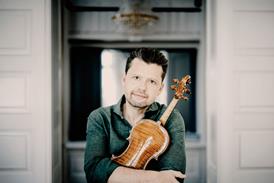
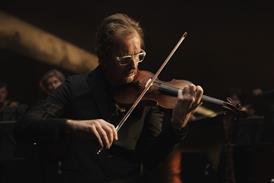




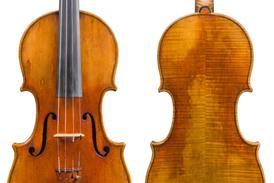
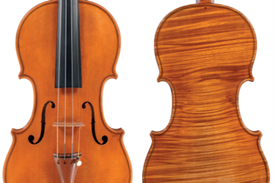
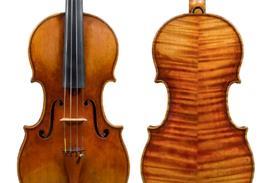




On the back of receiving a loan of a Stradivari violin, Daniel Kurganov shares how adapting to a new instrument can revolutionise your playing
Discover more Featured Stories like this in The Strad Playing Hub
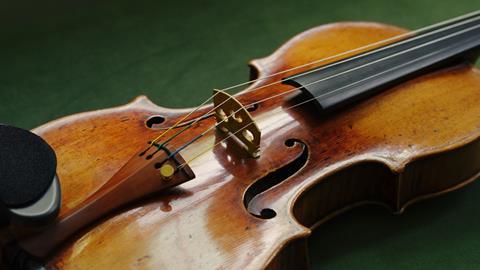
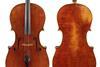
When I recently received a loan of a 1714 Antonio Stradivari violin from Carriage House Violins in Boston, I discovered something unexpected: getting used to a new instrument isn’t just about adaptation - it’s an opportunity for a complete technical reset.
This particular violin, from Stradivari’s golden period, carries remarkable history. It belonged to Franz Kneisel, founder of America’s first professional string quartet, and on this very instrument he premiered Dvořák’s ‘American’ Quartet. The Kneisel Quartet also introduced American audiences to works by Brahms, Debussy, Ravel and Schoenberg’s Verklärte Nacht.
But beyond its illustrious past, 1714 ‘Kneisel’ Stradivari became my teacher, forcing me to recalibrate every aspect of my technique. I have documented some of the insights in the video below, and whether you’re adjusting to a new violin or seeking to refine your current playing, these exercises and ideas just might transform your approach as well.
The three dimensions of intonation
In my view, every note exists in three dimensions: how it sounds, how it feels, and how it looks. When adapting to a new instrument, let’s recalibrate these elements:
Sound goes beyond simple pitch accuracy. Each violin has unique resonance patterns - certain notes excite sympathetic vibrations, air modes and body modes differently. Simply put, every violin has specific pitches where the air inside and the wood itself resonate together, creating those moments when the instrument suddenly ‘lights up’ with rich overtones. This Stradivari, with its slightly different string length compared to my personal violin, required me to rediscover where each note truly resonates.
Feel involves developing a physical map of your fingerboard. In fourth position, does your hand touch the instrument’s rib? Where does your palm contact the bout in high positions? These tactile landmarks become your GPS system. On the Strad, my usual reference points shifted slightly - what was a perfect fourth-position F on my violin was now slightly sharp. These millimetre differences matter.
Visual checkpoints might seem unconventional, but they work. From the player’s perspective, looking only with the right eye, one can see where one’s finger intersects with the wood of the instrument. The video expands on how surprisingly useful this can be in various situations!
Shifting without a safety net
Most violinists rely heavily on ’ghost notes’ - a sort of guide to accurate shifting. But practising ’air shifts’ removes this crutch entirely. You lift your finger, shift in the air, and land directly on the target pitch. It’s terrifying and potentially transformative.
Equally useful is my favourite shifting exercise: single-finger arpeggios, moving through all positions, strings and fingers. The pattern I use is quite simple, and doesn’t take long. The exercise also doubles as expressive training - treating each shift as a musical portamento rather than a mechanical motion.
Sound production reset
We know that sound production operates mainly on three interdependent variables: contact point, bow speed, and pressure. Many players get stuck treating these as separate parameters to adjust independently. Instead, I use an exercise called ’waves’ to integrate various parameters into a ‘feeling’ that one can manipulate.
Using consistent bow speed, create even and progressively deeper impulses with your index finger. This trains independence between your index finger/pronation and bow speed. More importantly, it sensitises you to your instrument’s unique capabilities: What are the pressure limits on different strings and positions? What are the optimal sound points for different kinds of sounds? This way, you’re manipulating various parameters ’under the hood’ without overthinking it.
This Stradivari surprised me. It accepts tremendous pressure without cracking as long as you maintain bow momentum. At the same time, it also produces that legendary golden, ethereal sound with the lightest touch. Each instrument has its own personality in this regard.
Chord playing as diagnostic tool
In the video, I use Bach’s Sarabande from the Cello Suites (sorry, cellists) as a perfect vehicle for recalibrating chord playing and coordination. Every instrument has a unique threshold for how aggressively you can ’carve through’ multiple strings. Some require a gentle roll; others, like this Strad, allow you to drive through with remarkable depth as long as you maintain momentum.
I also discuss the importance of careful finger placement - especially for 5ths! Even high-level players naturally default to more pressure to ’push’ the 5th into tune. This is counterproductive and not reliable!
The broader reset
I am always struck at the beauty of possibility that change brings. When everything feels slightly different on a new instrument, you can’t rely on muscle memory alone. You must return to conscious, deliberate practice - what neuroscientists call ‘deliberate variability.’
This recalibration opportunity doesn’t require a Stradivari. Any change - a new bow, different strings, even returning to playing after a break - can serve as a catalyst for technical renovation. The key is recognising these moments not as obstacles but as invitations to rediscover and refine your craft.
For violinists at any level, the message is clear: embrace change, and keep things fresh.
Listen to the 1714 ‘Kneisel’ Stradivari violin live in concert in the video below:
Read: Daniel Kurganov: on starting the violin at age 16
Discover more Featured Stories like this in The Strad Playing Hub



















No comments yet