







Through a career spanning classical cello and clowning, Karen Hall discovers that true success is not about getting everything right, but about remaining open, responsive and human
Discover more Featured Stories like this in The Strad Playing Hub
Tighten it. Loosen it. Rosin it. Set it down gently. Always use two hands. Always cradle the neck. Practise. Practise. Practise. Get it right. Get it in time. Get it in tune. Get it right. Get it better. Get it right. Get it in time. Get in tune. Get it right. Get it better. Get it right.
The mantra has lived in me since I began the cello at eight years old. With some piano before that (the instrument of my parents) and a long family history of music, it seems obvious I was destined for my successful career in the music industry.
Honestly, 30 years ago, I just hoped playing the cello would make this Rural-Town, homeschooled girl popular. Presented with choosing a string instrument to play, I reflected that my neighbour’s incredibly cool and popular cousin could: 1. Braid hair, 2. Make friendship bracelets, 3. Sing all the words to Green Day songs (even the bad ones!), and 4. Played the cello. Therefore, I deduced, playing the cello would make me cool and popular too.
So my mom would drive me to the neighbourhood elementary school for string classes where I would get out of that minivan, put on my cello backpack, and walk in past all the other kids lined up from recess just not at all cool. And while toting around an instrument roughly the same size and shape as myself did build a certain amount of credibility in a very small circle, it did not go very far in making me successfully popular.
Get it right. Get it in time. Get it in tune. Get it right. Get it better. Get it right.
The mantra played on as I strove for other versions of success, which in Rural-Town meant first chair of the high school chamber orchestra. Both my early private cello teachers had held it and I had been imagining it as mine for a decade. I longed for the principal chair and the approval. I qualified for state competitions and spent full Saturdays commuting to and from lessons hours away. My musical drive became the revenge of showing my withholding high school conductor, ‘Look, I am good at this!’ But never receiving the opportunity, well, in my mind, I was discouraged and I had failed.
I sent in a college scholarship application with a declared major of ‘Global Studies and International Relations’ and a VHS tape of me playing Saint-Saëns to see if I could pick up some extra money. Two weeks later the phone rang with a full scholarship offer if I would agree to be a music major in Big-City. Someone was saying, ‘Look, you’re good at this.’Success!
Get it right. Get it in time. Get it in tune. Get it right. Get it better. Get it right.
Full of self-doubt, conflict, and confusion I wrestled through my relationship with Cello. Unsure of how to let go of revenge playing and becoming recklessly set on doing it ‘my way’. My interpretation. My competition win. My best audition and the fights to make sure it reflected in my seating. My repertoire selections. My ideas for after graduation. My career highlights. My independence. My injuries.
At age 26, almost 20 years into my career, I found myself flat on my spasming back in my tiny studio apartment. My main job at the time was playing cello on the TV show Glee. Success! People knew me and I was popular. I had a steady, visible, union job and yet I had repetitive strain injuries bringing me tears each time I sat down to play.
Full of self-doubt, conflict and confusion, I wrestled through my relationship with Cello again. Showing up to gigs knowing I couldn’t play as well as the chair asked, knowing people were talking about it, knowing I needed the paycheck. Cello became this outside force I felt obligated to follow through for. Like Norman Bates’ all-present Mother, I knew, ‘a girl’s best friend ought to be her cello.’
Get it right. Get it in time. Get it in tune. Get it right. Get it better. Get it right.
The industry had decided what I was: a tall, blonde woman in her 20s who could play the cello pretty well when she wasn’t in debilitating pain or an ego-trip. She’d had some career highlights, didn’t have the pedigree of conservatory training or international wins, and was fit to play section cello unless the cameras wanted her to be more visible.
And then I found comedy and the world changed.
It sounds dramatic so I present you with two models:
Model Number One: Sit down to practise. You are on your own, in the practice room with a piece of music and your teacher’s notes. You play through. You get out your metronome. You choose 90 seconds worth of music to focus on. You slow down. You gradually bring the 90 seconds back up to speed. You read through your notes on the composer and the historical context of the music. You check the score. You decide the harmonic progression, the special notes, and the phrasing. You craft dynamic shape and work them to precision. You write in fingerings. You erase the fingerings. You write in new fingerings.
You repeat the process every day for months in isolated practice. Eventually, when you are ready, you bring it to audiences sharing with them your knowledge and gift. The audience decides whether or not to hear your interpretation live or to find someone else who’s already recorded it and put the track on as background music while they do their Saturday morning chores.
Model Number Two: You walk out onto a stage. You ask for a suggestion. You begin to make up a show where you can be anything and anyone with some other performers. Someone in the audience laughs. You hear that laugh and immediately recognise ‘this is what the show will be about because I want that person to keep having a good time.’ You are connected and creating in that moment, in real time.
Model Number One is likely a familiar lifetime practice for anyone reading The Strad. Model Number Two is shared by improv comedy and clown. Not the scary kind of clown. The kind where everything you do exists in relationship with your audience. There’s no fourth wall or hours of separation to get yourself prepared and there’s no…
Get it right. Get it in time. Get it in tune. Get it right. Get it better. Get it right.
Which is scary to most people. Because for the clown to get the laugh, the clown has to get it wrong. No one laughs at someone who has it all right. There’s no connection in success and there’s no humanity in perfection. The clown evolved in contrast to the super-human feats of the circus acrobats; offering it’s blundering counterpoint. It appeared in the courts of kings allowed to say the obscene and the true from the mouth of a fool. It’s history of mythical ‘tricksters’ throughout the world existed as a go-between for the divine and the mortal as a way to explain our shortcomings and triumphs.
And I was here for it. I was hooked and I could not get enough. Failure became success. Not a private pain of back spasms, not a chip-on-my-shoulder revenge, not a ‘practice makes perfect’ where you anticipate making mistakes you will fix and never make again. An actual public practice of giving something a try and having a human response to the outcome.
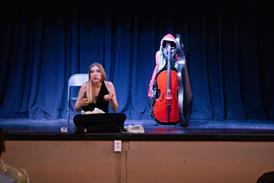
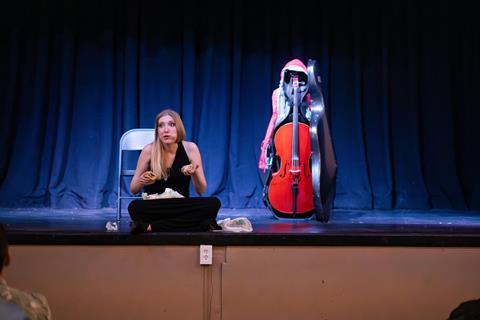
I looked at these contrasting models and I wondered if they could ever go together. Ten years into clowning, 30 years into cello playing, and five years into touring my solo show, Delusions and Grandeur – a solo cello recital meets a clown show in the world of the Jester, I’m forced to say yes. I can say yes because I’ve made my dream job and I love what I do. I can say yes because critics and judges have given me five star reviews and awards on three continents in the most competitive performing arts markets in the world. And I can say yes because people now ask me to talk about being successful.
But I don’t know yet if I’m successful. I’ve successfully let go of revenge-playing. I’ve successfully let go of the idea that I’m a ‘has been who once played on a union contract for a TV show’. I’ve successfully taught hundreds of kids to reveal their feelings, take a risk, and get curious through the tools of music education. And I’ve even found my way back to Global Studies and International Relations through performances in ten countries and counting.
The clown doesn’t hold their past. They bring where they’re at to the stage, they offer it to the audience, they allow the audience to be affected and are in turn affected by the audience. It is a deeply vulnerable and human practice of moving forward. In short, the clown may never succeed. They simply repeat the mantra ‘Give it a try. Aim for in time. Aim for in tune. Give it a try. Get it better. Give it a try.’
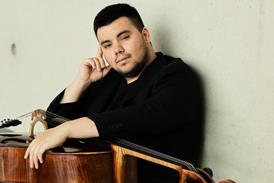
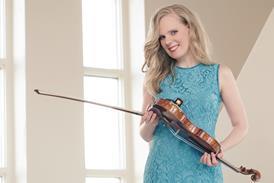
Karen Hall is a freelance cellist based in Los Angeles when she’s not touring the world. Her work can be heard and seen on Emmy-nominated soundtracks, the TV show Glee, and with orchestras around Southern California. Karen also designs and implements music curriculums as an arts educator in residence for Segerstrom Center for the Arts and The Music Center Los Angeles in order to help support her frequent clown habit. Her interests lie in evolving the performance medium to make truly immersive experiences for the classical music audience.
Delusions and Grandeur has upcoming tour dates this autumn in northwest United States: www.inforthelonghall.com.











No comments yet