






Richard Linnett reports back from the violinist’s performance of Dvořák, Beethoven, Dolores White, William Grant Still and Billy Childs on 11 April at Los Alamos Concert Association
Read more Featured Stories like this in The Strad Playing Hub
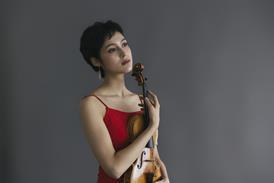
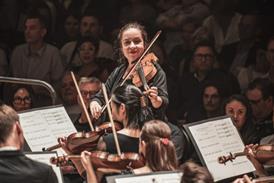
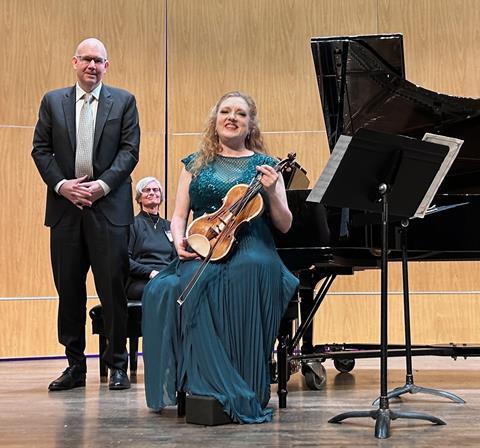
Taking a break from a demanding 2026 tour schedule of classic repertoire, Rachel Barton Pine dropped in on the Los Alamos Concert Association in New Mexico with a recital of selections from her Blue Dialogues: Music By Black Composers album.
Progressive music was the theme of the concert, even in the first half, which showcased a pair of classics. She introduced Dvořák’s Sonatina in G major, op.100, noting that like the composer’s Symphony no.9 ‘From the New World’, and his ‘American’ string quartet and quintet, the Sonatina was influenced by the music of Native and African Americans.
She called Beethoven’s ‘Kreutzer’ Sonata the ’Bridgetower’ Sonata, after Beethoven’s original dedication to the Afro-European violinist George Bridgewater, before the two men had a falling out and the composer rededicated it to the French violinist Rodolphe Kreutzer.
Both pieces, Dvorak and Beethoven, were superbly performed by Pine, accompanied by her stalwart pianist Matthew Hagle, who played with power and commitment. The second movement of the Sonatina, popularly known as ‘Indian Lament,’ was especially nostalgic and atmospheric, as Pine played it with a mournful, yearning tonality.
The second half of the programme dove deep into the blues. Pine began with Dolores White’s four-movement Blues Dialogues for solo violin, which displayed jazz and country music influences with plenty of chromaticism, double-stops and emotional drama. As expected, Pine made the piece feel effortlessly improvisatory but at the same time the structure was tight and consummate.
Hagle rejoined Pine for a rendition of Black composer William Grant Still’s arrangement of the beautiful African American spiritual ‘Here’s One’. This was quickly followed by what was arguably the thematic core of the programme, Incident on Larpenteur Avenue, a single-movement tone poem written by composer Billy Childs in response to the 2016 shooting of a Black man during a traffic stop by a Minneapolis police officer.
Pine introduced the piece as ‘following the proud tradition of classical music being used to shine a light on issues plaguing society,’ an uncanny echo of the recent fatal shootings of two protestors by ICE agents also in Minneapolis. The Childs piece was appropriately solemn and horrific, with augmented chords on the piano mimicking the sound of gunshots and shrieking violin bursts expressing the cries of onlookers and the victim; both instruments finishing on a tremendously sorrowful hymn.
The finale was a recitation of Grant Still’s grand Suite for Violin and Piano, composed as a paean to the work of three Black American sculptors. The performance exhibited a wide expressive range, from an explosive opening keyboard fanfare to a piano boogie and a syncopated, funky violin jam towards the end of the piece.
For an encore, Pine and Hagle performed a heartfelt version of Maud Powell’s arrangement of ‘Nobody Knows the Trouble I See’ by J. Rosamond Johnson. Pine prefaced the work, saying, ‘This is something that I think is very appropriate right now, for everything going on in our country and around the world.’ The sold-out audience responded with thunderous applause.
Overall, Pine’s programme was high spirited and high minded, intentionally and cautiously hopeful in the teeth of turbulent times. The artist was fragile yet strong, angelic and earthy, a teacher, mother and a very bright light; she entertained her audience while teaching lessons of kindness, acceptance and healing through great music.












No comments yet