






Hattie Butterworth visits Lonodn’s Wigmore Hall on 15 June 2026 for the recital of Ravel and Debussy
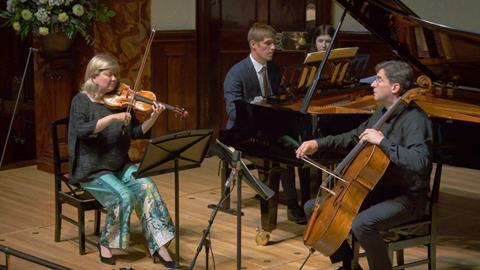
It’s quite easy to believe that Debussy was only 18 when he wrote his only Piano Trio in G major. Often dismissed as ‘salon music’, it certainly has an element of dramatic schmaltz. At this Wigmore Hall lunchtime concert, violinist Alina Ibragimova, cellist Christian Poltéra and pianist Cédric Tiberghien combined it with Ravel’s teeming Piano Trio in A minor.
If I were Debussy, I wouldn’t be happy that my early piece were heard alongside Ravel’s, though the musicians brought a renewed sense of poise and fluidity to the work. Ibragimova often brings an element of attack and speed to moments that don’t need it, but her ability to direct and hold a line is quite extraordinary. Poltéra’s technique is effortless, his singing sound perfectly judged for the Andante espressivo, with Tiberghien steering the group through the dancing Scherzo and accelerating Appassionato finale.
Ravel’s Piano Trio is a perfect work for these three formidable musicians. Again, Ibragimova’s towering sense of line came to the surface; so too did Tiberghien’s control of this borderline piano concerto. In the first movement, Poltéra’s control of his exposed high melodies and harmonics was extremely impressive. Occasionally Ibragimova’s articulation refused to match that of her colleagues in the second – a mismatch that could be distracting.
The darkness of the third movement’s Passacaille was magically pared back, giving the three space to build to the movement’s unison climax, with the finale’s harmonics and trills glistening against Tiberghien’s detailed, rigorous right-hand passagework. His solo sections favoured a solid sound above huge pianistic virtuosity, saving this instead for the movement’s explosive coda.
HATTIE BUTTERWORTH








No comments yet