
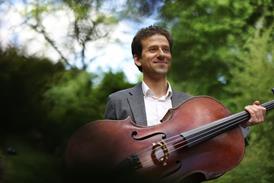




Mehmet Gökhan Bağcı interviews Turkish cellist Poyraz Baltacıgil on his recording of Bloch’s Prayer (From Jewish Life)
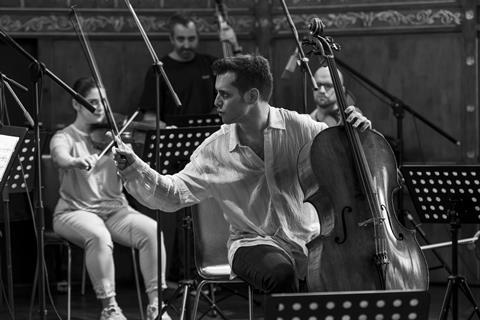
Read more Featured Stories like this in The Strad Playing Hub
The language of music is a resonance beyond borders, at times a lament, at times a hope, at times a silent prayer. With Bloch’s Prayer, Poyraz Baltacıgil shapes this frequency anew, his cello carrying both the weight of history and the intimate search of humanity. Each phrase unfolds as a personal whisper, yet also as a collective invocation, inviting listeners into a space where sorrow and hope coexist.
Baltacıgil gave his first public concert at the age of five and began his musical training the same year. Initially starting on the violin, he soon discovered his affinity for the cello and began his studies with Hakkı Öztürk at the Istanbul University State Conservatory.
In 2005, he was admitted full-time to the Mimar Sinan Fine Arts University State Conservatory, where he studied under Dilbağ Tokay and graduated in 2015. From 2015 to 2017, he completed his master’s degree under Jean-Guihen Queyras at the Hochschule für Musik Freiburg.
Alongside a solo career and recording projects, Baltacıgil also serves as principal cellist of the Borusan Istanbul Philharmonic Orchestra.
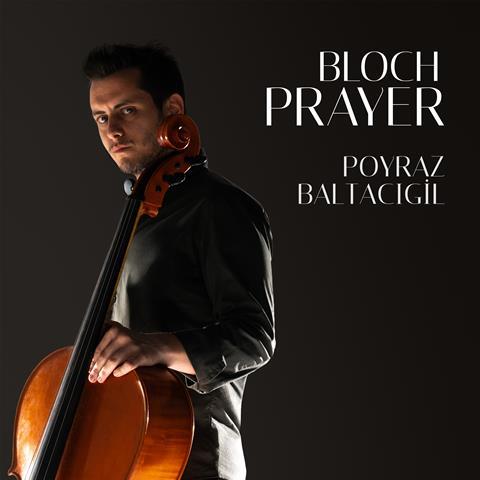
Released in 2025, this recording of Prayer stands as a fearless exploration of musical depth, a reminder that music is not merely an aesthetic experience, but a universal language that bridges cultures and beliefs. Bloch’s Prayer carries the weight of historical pain and humanity’s shared hope, while Baltacıgil’s interpretation brings this legacy into the present, offering listeners empathy and inner depth.
Recorded in Istanbul, in a setting where diverse symbols converge, the work transforms a personal whisper into a collective invocation. Through music, both the burden of the past and the hope we need today can be heard together, fearlessly and profoundly.
What personal memories or emotions accompanied you during the recording of this piece? Was there a moment when you felt a particular connection with the work?
The background to this piece is quite fascinating. It was composed with an ancient sensibility and a traditional religious perspective, which immediately drew my interest. Although I am not a religious person, striving to understand and give voice to such depths, while adding my own interpretation, reminds me that I am serving art.
Overall, it is a work that is sorrowful and sombre, yet at the same time tinged with hope; it also carries prayer and supplication, with moments of great sensitivity.
When interpreting a sacred work such as Prayer, how did you balance musical fidelity with personal interpretation?
By remaining faithful to the piece’s purpose, logic, religious content and narrative, we worked with the orchestra to capture a sound that was both majestic and pure. I can truly say that the sound I envisioned came through perfectly. And in the end, of course, I added my own voice and emotion, drawn from my heart and my musical background.
Bloch’s music carries a historical pain. How do you think music brings the past into the present? How did Bloch’s approach to expressing the ‘Jewish spirit’ through emotion resonate with you?
Almost all of his works tell the story of the Jewish spirit and its journey. The fact that a composer is so deeply rooted in his faith and reflects this devotion so strongly in his identity as an artist-composer feels rather traditional to me. But this is not a problem or an obstacle; I believe I have conveyed the message he wished to create, to leave as a legacy, and to impart effectively.
I hope the audience feels empathy when listening to this piece.
How did the world around you influence you during the recording? Why do you think the theme of ‘prayer’ returned so powerfully in 2026? What are people seeking in music today?
When we humans turn our gaze away, lose ourselves in thought, or wish to break free from routines, it is art, music, depth and philosophy that extend a hand to help us feel detached from this world; sometimes we even take flight. Everyone embraces and understands the concept of ‘prayer’ in their own way, and music is much the same.
What was the atmosphere like with the technical team and musicians during the recording? How did the energy of the environment reflect in the music?
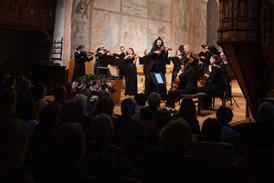
You might find this ironic and amusing, but I feel I must share it. The recording took place during Eid al-Adha, the Islamic festival of sacrifice, in Turkey, at the Yel Değirmeni Church Arts Centre, an old church. So, a Jewish prayer was recorded in a church, coinciding with Eid al-Adha.
We did not plan it that way; it simply happened. The technical crew and musicians were outstanding, each of the highest calibre. I would like to thank the orchestra and technical team, made up of the very best in their field. The atmosphere and energy were exactly as I had hoped.
Do you think the prayer in this piece was the prayer of a community, or a shared inner voice of humanity?
To me, it feels closer to the inward cry of an individual. While there are moments where it is heard and felt outwardly, when I look at it harmonically and as a whole, it feels profoundly deep and introspective.
Although I do not have the expertise to interpret it from a religious perspective, when I imagine it culturally, I think it is a music, a melody, that carries profound emotions, sorrow and hope, whilst also containing supplication and conveying many social messages.
Do you think a cello’s sound can carry the spirit of the diaspora? In other words, can it convey both loss and hope at the same time?
I think it is very relative. When I play my cello to tell a story, to try to speak, I feel more authentic, more truly myself, more ‘Poyraz’. So, in my view, it is indeed possible.











No comments yet