




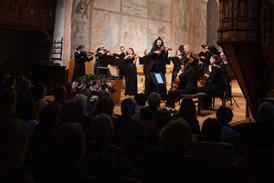



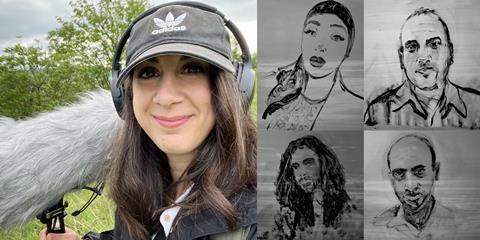
Ahead of its premiere recording by the ensemble Alarm Will Sound, composer and documentarian Mary Kouyoumdjian discusses her sonic documentary, Paper Pianos, which tells the story of four refugees
Read more Featured Stories like this in The Strad Playing Hub
How did the project first come about?
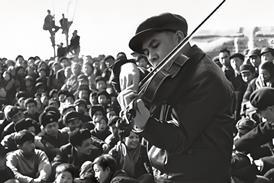
I first met Milad Yousufi in 2016, who had come to New York City from Kabul. He had taught himself piano in Afghanistan, where music was forbidden under Taliban rule, by drawing keys on a piece of paper and silently practising. When he came to the United States, he would come play piano at my house, and it became clear to me just how much he wanted people in the US to value their freedom of expression.
I wanted to share his story and first started with a ten-minute work centered on Milad. Then Nigel Maister [co-creator of Paper Pianos], and I met three other refugees – Getachew ‘Gee-Gee’ Bashir from Ethiopia, Hani Ali from Somalia and Akil Aljaysh from Iraq – who were working as resettlement workers in New York. We interviewed them too, and these conversations, as well as Milad’s story, form the basis of the 90-minute sonic documentary of Paper Pianos.
What exactly is a ‘sonic documentary’?
For me, a sonic documentary integrates sounds of concrete, real-world material in a work. In our case, we use recordings from our interviews, paired with music. Music invites the listener to reflect on, process and digest what they are hearing in the spoken word – they can more easily place themselves into what they are hearing and relate with the subjects’ stories.
Tell me about the work itself and how it is constructed
Nigel Maister essentially created a libretto with the interviews and I wrote music surrounding it – similar to an opera. My primary focus was for the music to represent the psychological trajectory of the interviewees. This invited a lot of textural writing, to avoid clashing with the spoken word.
There are still extended periods of only music that let the audience process what has happened. For example, Milad tells the story of seeing a play in Kabul about suicide bombers, but then a suicide bomber actually detonated a bomb in the middle of the performance. After that kind of story, you can’t just jump into something else – music can allow the time and space to absorb what just happened.
How is the piece structured?
The work can be seen in three parts. In the first part, you get to know each of the subjects, and you get inklings about why they had to leave their countries. We jump a lot between the stories, so the tone and music change quite often.
In the middle section, we go deeper into the horrors of what they have experienced – particularly Milad. There are long musical ideas that relentlessly build for around 30 minutes. There’s really a sense of discomfort in this part.
The last part is quieter and you process what you’ve just heard. It also reflects the experience of acclimatising in the US, with both a feeling of hope and sadness. While they’re grateful to be here, there’s also a sense of loss. The piece ends with a question mark. How will each of these individuals now continue their lives in the United States?
Tell me about the musical material itself
The music is predominantly textural, but still with some melodic material. In those moments, I tend to pull from folk music. There are sometimes drones on top of which I build textures, or I use certain modes. In the parts where there is only music, this serves as an extended transition, setting up what’s coming next.
The music can often create an uncomfortable sonic space. This discomfort is important, otherwise the piece isn’t doing its job. I want the audience to remember how they felt so that the topic of the refugee crisis sticks with them.
How are strings in particular used?
I just love strings. Of all the instruments, they are the most human. For example, in this piece, I like to include pitch bends in the strings to create tension – it makes it sound very human rather than something perfect and polished.
The strings often take on the melodic material. I keep these melodies simple – something you could sing after hearing a few times. And seeing as they are often inspired by folk, they are usually playing non-Western styles, for example Arabic string techniques with lush phrases and soulful vibrato. I was particularly influenced by the kamancheh instrument, on which sliding between notes is common practice.
That said, there are moments of virtuosity where the music is intended to feel incredibly overwhelming; frantic tremolo or open note head passages where they need to play incredibly quickly. And the physical exertion needed to play that also reflects the intensity of the subject matter.
You mention that the music can create a sense of unease, how do the strings fit into this?
There are parts where glissandi will nearly meet a drone, and it creates an uneasy sense of seasickness. Sometimes they play melodies in harmonics, which while beautiful, have a certain hollowness. And sometimes they make fluttering sounds, like a moth next to your ear or phantom aftershocks of loud explosions.
How do you approach writing political works?
I’m very deliberate about it. I feel incredibly privileged to live somewhere with such freedom of expression and I feel a great responsibility to use that freedom not just to write beautiful music, but to attempt to say something meaningful.
I never want to alienate the listener and tell them what they should or shouldn’t be thinking. My approach is that people won’t care about these topics unless they care about the human stories behind them. If we experience discomfort in art, we are more inclined to act, because we want to see less discomfort in our world. I invite the listener to connect to these experiences that might feel far away from them. If they then encounter these topics later in life, they may feel a little more open to acting on them.
The primary focus of the piece was to draw attention to supporting refugees, and there’s already been tangible effects. Through support from the community, Milad was able to study piano and composition at college, he got a teaching job, has his own piano, and has accomplished so much as an active musician in the United States. He’s an incredible human who has taken his new-found freedom and makes the very most of it.
The world premiere recording of Paper Pianos will be released on 7 August. Artist proceeds from the album will be donated to the International Rescue Committee.
Read: Outside the practice room: the value of summer festivals
Read: Colorado Music Festival: 50 years of music beneath Boulder’s Flatirons
Read more Featured Stories like this in The Strad Playing Hub



![Ayanna Witter-Johnson [Jordan Woods] 7](https://dnan0fzjxntrj.cloudfront.net/Pictures/100x67/4/9/4/44494_ayannawitterjohnsonjordanwoods7_224583.jpg)






No comments yet