

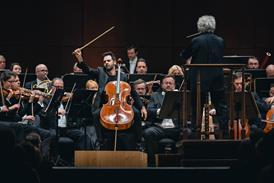
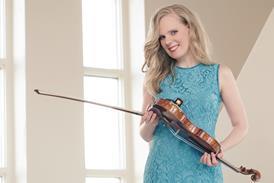






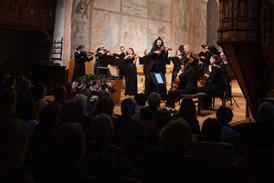




Scottish smallpipes player Brìghde Chaimbeul on blending and tuning pipes and strings in her new work for the Scottish Ensemble, which will be premiered at the Edinburgh International Festival

Read more Featured Stories like this in The Strad Playing Hub
Tell me about the story behind the piece
In terms of storytelling, it’s very much inspired by the way the moon appears in Gaelic folklore. So I separate the piece into two movements – the full moon and the new moon.
The full moon is often linked to themes of horror, darkness and something slightly unsettling – as if the veil between worlds is a bit thin. And the stories I’m thinking of in terms of the full moon actually come from Skye, where I’m from.
As for the new moon, it’s always been something praised or worshipped – something to look forward to. There’s a bit more of a positive light to it.
How have you translated this into music?
The first movement, which doesn’t include pipes, opens with a very slow moving, deep drone. It explores the effect that can have on your ears, especially when you have that many strings resonating in the specific tuning we use in this piece – because the pipes are in C mixolydian and in just intonation, the strings have needed to adapt to this and tune differently. So I think it’s quite important to sit in these drones for several minutes to start noticing what’s going on sonically.
The second movement has elements that people will recognise from traditional Scottish music. And when the pipes enter, they’re tuned in quite an odd way. I wanted to move away from what typically happens in bagpipes and classical crossovers, where the pipes enter with some sort of fanfare. Here, the pipes’ entry is kind of like a dream world. As it progresses there are elements of Scottish music. Even though the melodies are my own, they’re based on traditional rhythms and tunes.
How have you found blending pipes and strings, particularly considering the different kind of tuning?
Even though we can play in the same range, the tone is completely different. So it was really important for me to tune the strings with the pipes to make them blend more. I wanted to write the piece so that the pipes were more part of the ensemble, and we become just one sound.
How did this tuning affect the strings’ sound?
We tuned all the strings in just intonation against a C. So moving away from the A anchor that strings usually tune to means the open strings resonate differently. All of a sudden, it’s the cello’s open C string that becomes the anchor.
So there’s also a lot of manual tuning and adjustment that players have to just do with their fingering. It’s definitely a process and can take up to 20 minutes to get all the strings in the correct tuning.
Is there also a difference in timbre?
I think it’s quite subtle. A few of the players thought it felt more mellow and earthy. I think it was quite unsettling at first for some of them. But even though it’s subtle, it’s definitely big enough of a contrast to feel in your body that something is different.
And as a composer, how do you like writing for strings?
I think there’s a lot of flexibility there and a lot of scope for any type of tone. I especially like working with the lower end of the string ensemble. As a piper, my instrument is very one-dimensional, without many dynamics. You’re either playing or you’re not. So having that flexibility is really interesting. And just to work with these string players in particular is really an honour. They’re such skilled players.
Find more information here about the Scottish Ensemble’s performances of the work













No comments yet