





![Ayanna Witter-Johnson [Jordan Woods] 7](https://dnan0fzjxntrj.cloudfront.net/Pictures/274x183/4/9/4/44494_ayannawitterjohnsonjordanwoods7_224583.jpg)




Violinist and artistic director of the Phaedra Ensemble Phillip Granell explores the string techniques used in Monk’s work, which was commissioned by the Kronos Quartet in 2004
Discover more Featured Stories like this in The Strad Playing Hub
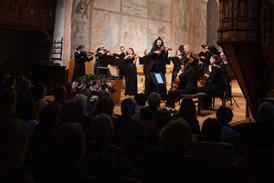
Meredith Monk is best known for her pioneering work with the human voice, exploring extended vocal techniques within a body of work in which music, movement, theatre and image are closely intertwined. The string quartet therefore occupies an unusual place in her output but also serves as an important entry point to the instrumental works that are the focus of our debut album, Realms. Written in 2004, Stringsongs is, to date, her only standalone work for string quartet, commissioned by the Kronos Quartet and premiered at the Barbican in London in 2005.
For me, Meredith Monk’s Stringsongs is almost a microcosm of her vocal music, transported into our world of the string quartet. Across four very different movements, the piece contains so much of what makes Meredith’s music distinctive: breath and voice, rhythm and hocketing, dance, striking visual imagery and, above all, a very direct sense of human expression.
When Meredith was discussing the commission with the Kronos Quartet, she even wondered whether she might include a voice. David Harrington encouraged her to write for the four string instruments alone.
Working with Kronos was central to Meredith’s development of Stringsongs. As she wrote of the process, ‘I explored using instruments to create unexpected textures and sounds in much the same way that I have worked with the voice over many years.”
This deep way of working suits Meredith; she is a collaborative musician at heart: someone who wants to make music with people as much as for them. That has certainly been our experience in Phaedra Ensemble. Our work with her on Stringsongs took place largely over Zoom, and those enlightening conversations became the bedrock of our understanding of what lay behind the score.
The notes and rhythms are precise, but it is often Meredith’s descriptive language that gives them their weight and character: a ‘glassy, sizzling sound”; ‘shakuhachi sound”; ‘ecstatically”. A word or an image can fundamentally alter what you physically do with the instrument. Meredith once said of her music, ‘I don’t think that you can completely capture the essence or the principles of my music on paper.” Once you start talking with Meredith, this becomes very clear.
The opening movement, Cliff Light, is perhaps the most obvious example. Meredith wrote much of Stringsongs in New Mexico, only later realising how much its rugged, light-infused landscape had shaped the music. The extraordinary light there, constantly shifting across craggy, bare rock, seems embedded in the piece.
As first violin, I feel this in the slicing double stops of my first entrance: shards of light cutting across the texture. The second violin’s opening exploding chords seem to reverberate across bare rock at dawn.
Technically, the movement is demanding without being conventionally virtuosic. Its exposed fourths and fifths present considerable intonation challenges, and the meter and entries across the bar are rarely the same twice. But there is also the question of how the bow moves. I have always felt something of the accordion’s bellows in Cliff Light: the bows inhaling and exhaling, the quartet often expanding and contracting as one. Meredith’s background as a singer makes thinking in terms of breath natural; we talked about the ‘breathing’ of the bow arm.
At the end of Cliff Light, Meredith asks for ‘a glassy, sizzling, burning sound in the sustains’. She describes light falling across canyon mountains late in the afternoon. For this sound, we used slow bows with a fast, heavy attack at the beginning of each gesture. Open strings fuse with stopped fifths and fourths to create shards of light that die away; changes of note in the first violin and cello bring the chords to unsettled, sizzling ends.
Tendrils, the second movement, inhabits another world, undoubtedly the organic, beating heart of the piece. Built around a simple motif of rising fourths, the movement opens with the first violin soaring high above the intertwined lines of the lower instruments. Meredith writes beautifully for the cello here, a melody in stopped harmonics, before the music breaks out into a sonorous waltz. But there is a constant sense of forward motion.
At one point the music dies down to a pianissimo, sul tasto section. The notes are accented and the direction is simply ‘shakuhachi sound”, after the traditional Japanese bamboo flute. In the recording sessions, we experimented with how to make a bowed string instrument speak in that way.
Our eventual solution involved playing somewhat sul tasto, though not excessively so, and using bow speed to shape each note. A very fast initial movement of the bow produces the accent, almost a bell-like articulation, followed immediately by an extremely slow bow, with little weight. The effect is less about sustaining a beautiful conventional sound than allowing the attack itself to resonate. Above this, the cello weaves a delicate melody played in stopped harmonics.
We take this to an even greater extreme in the hocketing section at the end of the movement. In hocketing, a melodic line is divided between performers, with notes or fragments passed from one to another. It is also central to Meredith’s own vocal practice. She has described performing a hocket as being like a tightrope walk.
That is exactly how this passage feels to play. Each player has only a fragment, and the line exists somewhere between us. Technical and rhythmical security is necessary, but making it too safe would lose something essential!
The slow Obsidian Chorale brings another aspect of the voice into the quartet. Meredith describes its ‘long, breathing lines” as ‘one big instrument, almost like a giant accordion or harmonium.” Here, four separate bows need somehow to breathe together.
This is one of only two places in the score where Meredith specifically indicates whether or not to use vibrato. Listening back to our takes, we generally preferred vibrato, particularly in the lyrical passages, and even in the forceful chords of Cliff Light. In Obsidian Chorale, however, the music is specifically marked NV. We try to observe this consistently, giving the harmony a solid, rock-like, timeless quality.
The final movement, Phantom Strings, returns us to energy and movement. Meredith told us that she initially created the individual lines with her own voice, layering them up through a 4-track recorder before transcribing them onto the page.
During one Zoom session, she sang its opening rhythmic figure to us: ‘dum di di dum di di dum di di di di di di dum…’. Suddenly something that we had been trying to understand from the notation became obvious. Her voice showed us where the weight fell, giving the music the feel she wanted.
For the opening Meredith gave us another wonderfully simple image: two people far apart down a long road, walking towards one another. The violins begin with contrasting colours, sul tasto and sul ponticello, both starting at pianissimo, gradually moving together, getting louder before the lower instruments enter and the four lines become increasingly intertwined. The music builds in one enormous trajectory. It dances, but to me it is a grounded dance, feet on the floor rather than ballet en pointe.
That physicality runs throughout Stringsongs. Breath becomes bow movement; vocal articulation becomes an attack; hocketing becomes four players leaning on one another and dancing together.
For all these challenges (and joys!), what makes Stringsongs so satisfying is ultimately its transparency. And perhaps that is what I love most about performing it. There is an honesty to Meredith’s music that gives you nowhere to hide. You have to inhabit it. Beneath all the unusual colours and techniques, Stringsongs is profoundly direct music: four instruments discovering how to breathe, dance, listen and, ultimately, sing.
Phaedra Ensemble launches its debut album ‘Realms’, on which Stringsongs features, with a complete live performance at Kings Place on Thursday 17 September. ‘Realms’ is released on Cantaloupe Music on Friday 18 September.
Read: Writing for strings gives the possibility of hearing many voices: Olivia Belli
Read: Pulling at the heartstrings: why record music that has been recorded many times before?
Discover more Featured Stories like this in The Strad Playing Hub

![Ayanna Witter-Johnson [Jordan Woods] 7](https://dnan0fzjxntrj.cloudfront.net/Pictures/100x67/4/9/4/44494_ayannawitterjohnsonjordanwoods7_224583.jpg)







No comments yet