








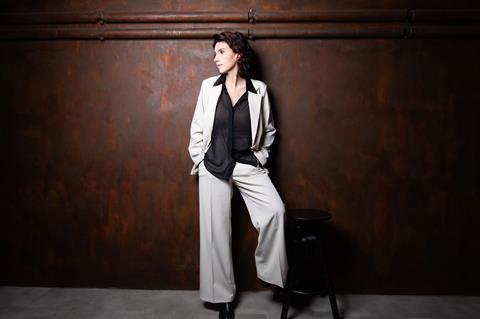
Pianist and composer Olivia Belli shares how writing for strings provides countless opportunities for expression her compositions, including her work DAIMON, inspired by The Odyssey
Discover more Featured Stories like this in The Strad Playing Hub
I am a pianist and a composer, so of course the piano is at the centre of my musical life. But when I compose I don’t really think of it as one instrument. I hear voices.
I grew up with Bach. His music has been with me all my life and shaped very deeply the way I understand music. One thing that has always fascinated me is that his music does not really belong to one instrument. You can play it on another instrument, you can change the ensemble, and somehow its beauty, its purity, its meaning are still there.
Maybe this is also where my obsession with different lines comes from. I love voices that overlap, cross each other, go in different directions, sometimes even with different rhythms, but still belong together. In Bach every line has a life of its own. And still, it needs all the others.
I have always tried to bring something of this into my piano writing. Sometimes I feel I am trying to make the piano into an imaginary string quartet.
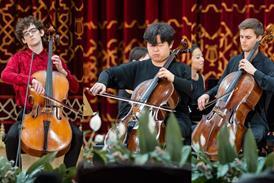
And maybe this is why writing for strings feels so natural to me. With a quartet, what I normally imagine at the piano becomes real. There are four voices, four colours, four people breathing in their own way, but they have to breathe together too.
I also love doing the opposite: taking music written for string quartet and transcribing it for piano. I learn a lot from doing this. Suddenly I have to put four different voices under ten fingers and really understand where each of them is going, and why.
There is another thing about strings which fascinates me, especially as a pianist, and it is very physical. With the piano everything happens in the moment you touch the key. Of course there are so many different ways of touching it, and this changes everything. But after that moment, the note is gone from your hands. You cannot do anything more to it. You can only listen to it disappear.
With a string instrument it is completely different. The bow can continue working on the sound. A note can grow, change colour, become more intense or more fragile while it is still alive. I find this possibility fascinating.
When I choose a string instrument for one of my pieces, though, I am not really choosing a colour. I am looking for a voice.
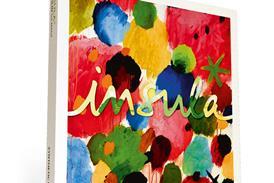
This happened very clearly with DAIMON, my album inspired by The Odyssey and by the idea of the inner journey. Strings are everywhere in this project, but they have very different roles.
The Piano Concerto, for example, exists in two versions, one with chamber orchestra and one with string quartet. The piano is Odysseus. It is the individual, travelling and searching for his nostos, his return home. I needed the strings because I needed the others around him. The world he meets. Sometimes they go with him, sometimes against him. There had to be this dialogue between one person and many voices.
When I choose a string instrument for one of my pieces, I am not really choosing a colour. I am looking for a voice
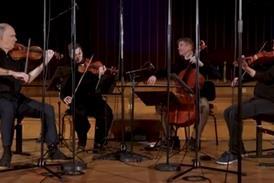
Then there is Proci, which is for string quartet, but here I needed something completely different. The suitors are not noble characters. There is arrogance in them, and violence, both inside and outside. So the quartet had to become more restless, more physical, sometimes almost unpleasant.
But I didn’t want only violence. There is something very sad behind it. These men are consuming the home of Odysseus and Penelope without any care. This is their home, full of their memories, their life together, and it is being taken over and consumed in front of them. So I needed the melancholy too, and the four voices allowed me to express both feelings at the same time.
For Laertes, instead, I immediately heard one voice: the cello.
Laertes is Odysseus’ old father. He has almost given up hope. He lives apart from the world and takes care of his garden, of the trees he once planted with his son. I found this image incredibly moving. There is so much love there, but also absence and silence.
I imagined the cello almost like an old Baroque aria without words. A very simple, long human line. And when I thought about who could play Laertes, I thought of Raphaela Gromes. There is an honesty in her playing, a purity, that I felt was right for him.
Odysseus’ son Telemachus was exactly the opposite. He is young, restless, sometimes impetuous. He has all this energy and he still has to understand where to put it. For me this was the violin, and Eldbjørg Hemsing had the qualities I was looking for: warmth, agility, but especially this feeling of energy that is always moving.
This is normally how I work when the project is mine. First I have the idea, then I understand which instrument I need, and after that I start thinking about the musician.
With a commission it is the other way round, because the musician is there from the beginning. I actually enjoy this challenge. I listen a lot before writing. I try to understand their sound, how they make a phrase, what I particularly love in their playing. I don’t want to write a portrait of them, but I want to leave space for who they are.
With Gautier Capuçon, for example, I wrote Tàmâr Mĕtūshelāḥ for a project about the Earth. I didn’t want to write about destruction. I became interested instead in resilience, in this extraordinary capacity of life to wait, survive and start again. The cello could hold something ancient and, at the same time, the idea of renewal.
Sapias, for Mari Samuelsen, was another experience. Her playing has such strength and physical presence. I also find something romantic in her, in a contemporary way. She is not afraid of emotion or intensity, and I wanted the music to have space for this.
Then with Esther Abrami and Naïás I needed something else again. The piece was written for a project celebrating women. The Naiads are the female spirits of fresh water in Greek mythology, and I wanted something light and feminine in the violin. Delicate, yes, but not fragile. And somewhere inside the piece there is also a small, distant tribute to Schubert.
Over the years I have written for many combinations of strings: solo cello, cello and piano, violin and piano, viola and piano, string quartet and trio, piano and strings, larger string ensembles and chamber orchestra. And every time I have to think a little differently.
But I always come back to the string quartet. Four instruments already give you so much expression, and still you have the intimacy of chamber music. Every line is exposed. There is nowhere to hide. Each musician has a real responsibility for their own voice.
With a larger string ensemble something changes. The individual lines can start to become one body of sound. But what interests me most is moving between these two possibilities: hearing the individual voices and then hearing them become something larger.
And at the end what I am looking for when I choose an instrument is not only a sound, but something that can become a person, a memory, sometimes almost a human voice.
Maybe this is why I love writing for strings so much. They give me the possibility of hearing many voices, even when I am writing something very intimate. And perhaps this is also what I have always been looking for at the piano.
The quintet version of DAIMON will premiere at the Southbank Centre, along with the premiere of Olivia Belli’s work Terpsichore for guitar and string quintet, on 10 September 2026.










No comments yet