







In a rare musical encounter in London, a 330-year-old masterpiece and a cutting-edge carbon fibre violin come together to perform Bach, revealing how craftsmanship, old and new, can harmonise on equal terms
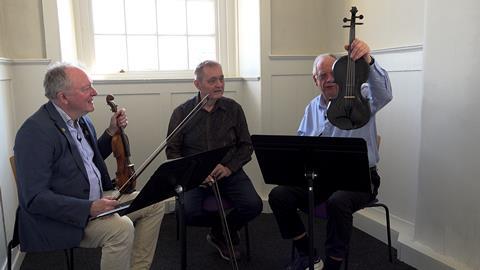
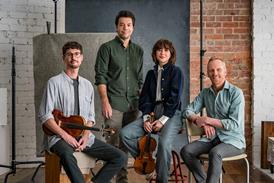
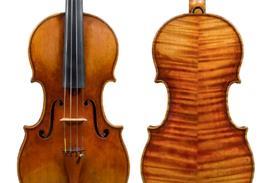
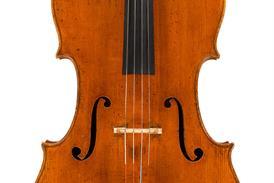
After 330 years, two very different violins came together in London to perform Bach’s Double Concerto (BWV 1043). One was a Stradivari, played by Andrew Bernardi; the other was a modern instrument made entirely of carbon fibre by George Man C., played by Andy Laing.
This was not intended as a competition, but rather as a musical meeting between tradition and innovation. The purpose was simply to make music together. At the same time, the carbon fibre maker saw this as a tribute to traditional violin craftsmanship and to the old masters, whose beautiful sound he deeply admires. His goal was not to imitate them, but to pursue the beauty and magic of tone in his own distinctive way.
It was a spontaneous yet slightly tense encounter. For Manfred – working under the stage name George Man C. – making music together is his response to the critical views often expressed about carbon fibre instruments.
The violinists did not know what to expect, as it was their first time playing the black violin and the Black Ibis bow. After just fifteen minutes to become familiar with the instrument and warm up, the camera began recording.
Both the carbon fibre violin and the bow impressed with their dark, warm, and distinctive tone. From the very beginning, the two violins blended beautifully; despite their different personalities, they seemed perfectly matched. They were also remarkably powerful, filling the room with sound.
Andy Laing later wrote to George Man C.: ’It was a great day and a privilege to play your carbon fibre violin. It had such a beautiful sound, and it was easy to adapt to your revolutionary design
’I was truly impressed by the tone produced by Manfred’s cutting-edge technology. Like Stradivari, Manfred never seems to be satisfied and is always striving to improve, experimenting with new ideas and formulas. As with all great innovators, he continues to explore different designs and measurements in his pursuit of perfection.’
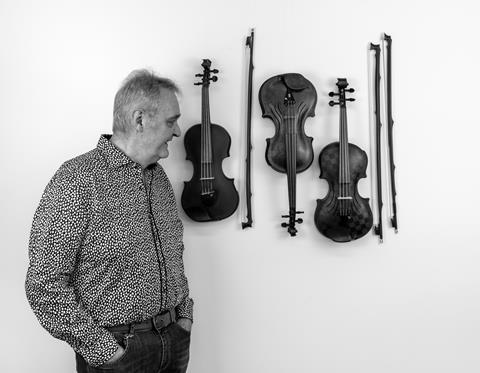
Why carbon fibre violins and bows?
Carbon fibre opens up design possibilities that would be difficult to achieve with wood. This allows for innovative approaches to exploring the nature of sound through experimental changes in structure, materials, and construction.
The musical encounter between the GMC violin and the Stradivari demonstrated that they can perform together on equal terms.
George Man C. explains: ’The violin is an ingenious tool, but the true creation is its sound. Developing that sound requires complete dedication from its maker. I believe that stringed instruments and bows made from carbon fibre have the potential to compete at the highest level of classical music. They can enrich the listening experience with an additional warm and expressive tone.
’Establishing a school for such instruments would be an ideal way to pass on my knowledge and encourage further development. However, this would require the support of partners or foundations to become a reality.’

‘My inspiration is to follow and understand the mysteries of sound. Development with carbon fibre is still in its early stages’
Left: painting by George Man C. ’Hidden Secrets of the Lady in Black’ - oil on laid paper










No comments yet