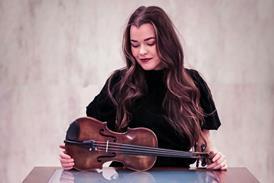
Sam Zygmuntowicz examines the large proportions of this 1796 Mantegazza viola, which give it a powerful sound that makes it ideal for string quartets. From December 2003

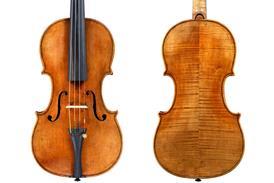
Mantegazza viola side view

While viola soloists normally seek small instruments, many fine string quartets are anchored by the deep sonority of larger instruments. Of these, none is more commanding than this 1796 Mantegazza viola in the hands of Lawrence Dutton of the Emerson Quartet.

Pietro and Giovanni Mantegazza, along with Pietro’s sons, were prominent experts and dealers who worked for Tarisio and, later, Count Cozio di Salabue, whose great collection of Cremonese masterworks they maintained and modernised. In this capacity they were among the first in a long tradition of makers who were also skilled restorers and brought this practical experience to their own creations.

This imposing instrument resembles large Amati tenor, with grand proportions, graceful lines and voluptuous arching - all within a manageable 17-inch  body length. The violin-style scroll, without cheeks, allows a comfortable first-position vibrato, adding to the playability. The bridge was later repositioned to give a shorter string length. Tonally, the high arches and high ribs create a dark, cavernous bass, while the strong edges and deep, wide arching channels provide ‘sizzle’ and clarity, defining and intensifying the sound. The even-grained spruce and mild, lightweight maple is acoustically excellent and the remarkably well-preserved, gold-brown varnish is rather thin and hard, adding some additional brilliance.

A strong player can push deep into this thick envelope of sound to find a clear projecting edge. Pietro was initially trained by Carlo Landolfi and the early work shows a similarly brusque style. However, the family’s work soon displayed greater precision and refinement, and the ebony purfling, scooped scroll carving and smooth, highly finished surfaces suggest a French influence. The front and back archings are almost identical, with a rounded profile and wide, elegant channelling. The outline is precise, but the variable edge overhang indicates rib construction either without a mould or using an outside mould.

The modern maker might well feel a strange affinity with the makers of this 200-year-old viola: the golden age was well past and, like us, the brothers could look back to older works for inspiration, adapting their designs to the evolving playing styles of the day. Using their own diverse techniques, they managed to recapture some of the old style while successfully adding a personal touch. As for the famed varnish of the Cremonese masters? Alas, it had already gone!

Mantegazza viola scroll

Dimensions 

Back length
432mm

Upper bouts
210.5mm

Middle bouts
144mm

Lower bouts
261mm

Stop length
226mm

Mantegazza viola front view

Read: Making copies: Sounds like a match?

Read: In Focus: From Strad to Slava


Making copies: Sounds like a match?

Adjusting Zyg copies 2-1

If someone makes an exact copy of a Stradivari, will it sound like a Stradivari? Sam Zygmuntowicz attempts to answer the question by making duplicates of the ‘Titian’ and ‘Willemotte’ Strads, as well as the ‘Plowden’ Guarneri ‘del Gesù’